
Dark Water

We sense there is some sort of spirit that loves birds and the animals and the ants — perhaps the same one who gave a radiance to you in your mother’s womb. Is it logical you would be walking around entirely orphaned now? The truth is you turned away yourself, and decided to go into the dark alone.
— Kabir
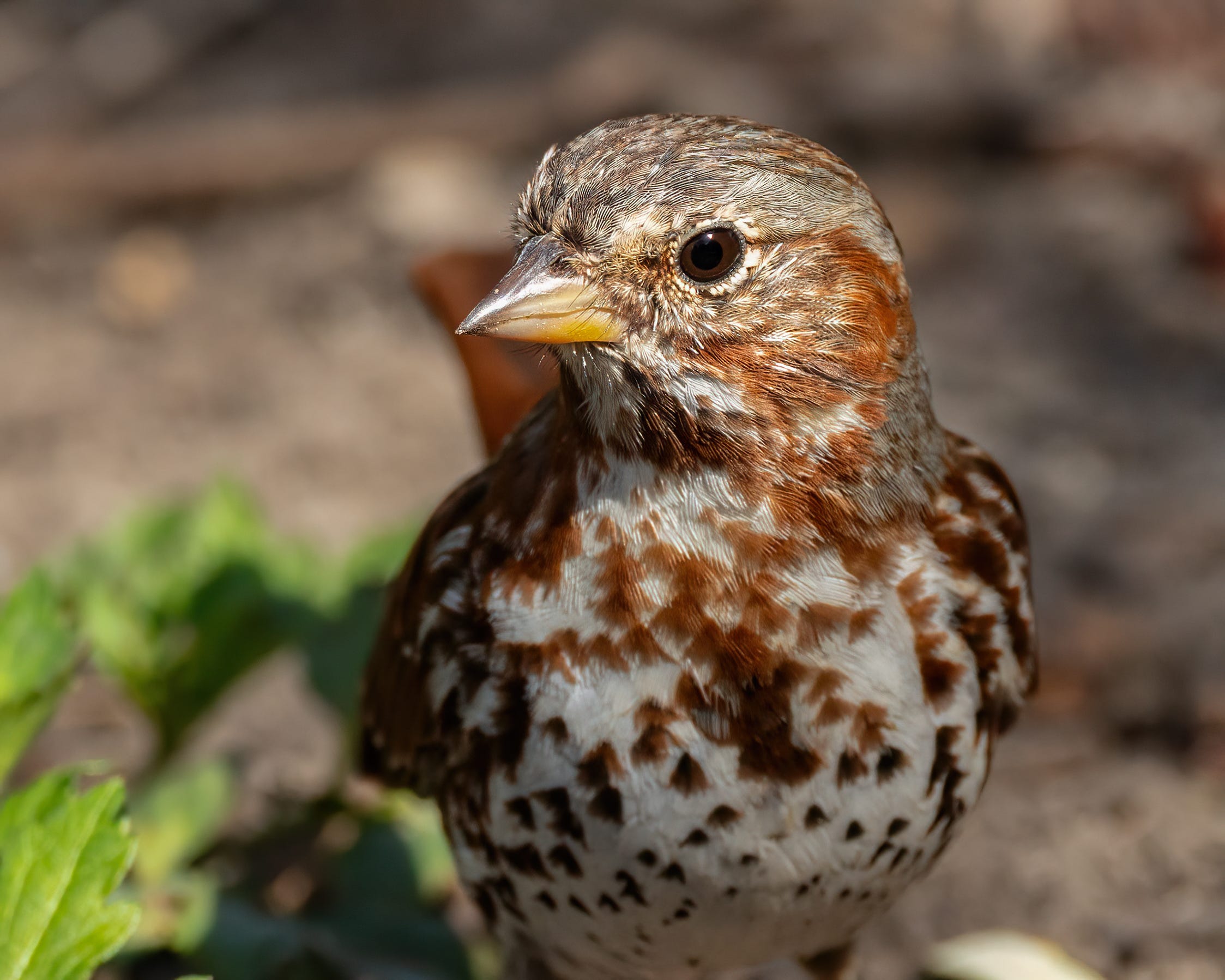
I saw a rusty red flash the moment I stepped out the back door. A Fox Sparrow was scratching through the leaf litter at the edge of my pond, twenty feet away. I froze. Then, slowly, I backed up and slipped back inside my house.
This is what the bird does to you. It makes you disappear yourself.
I grabbed my camera, stepped outside, and approached a camouflaged blind I’d set up overlooking the pond. I had to round the garden gate, and for a moment was briefly exposed, in full view of the sparrow. I kept moving and stepped through the opening into shadow.
Inside, I hugged the back wall, edging around the perimeter, and slowly lowered myself into a chair. The whole time I was certain the Fox Sparrow would be gone, that the gate, the exposure, the sound of my weight settling would have been enough. I leaned toward the small opening in the fabric and looked out.
He was still there. Six feet away doing that quick double-scratch, both feet raking backward simultaneously, absorbed completely in the moment, eating seed on the ground. A thought flashed through my mind: The light will betray me. I brought the camera up slowly, off to the side, keeping it behind the fabric, then leaned into the opening and began to take pictures. The rufous chevrons on the white chest. The patches of warm gray. The reddish tail. A boreal bird, bringing the north woods to my yard.
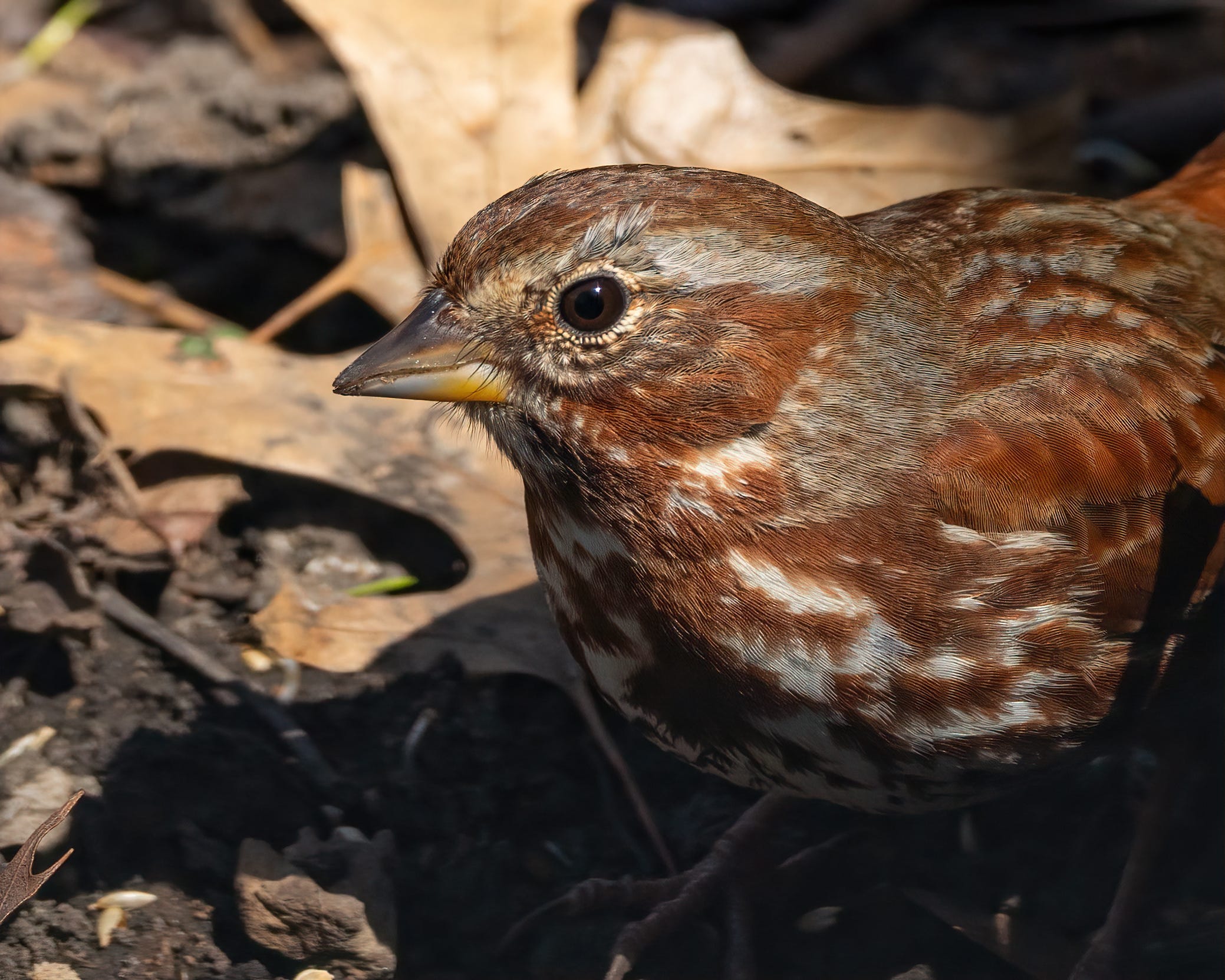
I am still not sure if he tolerated my presence or if he simply hadn’t seen me.
Then he turned and began moving in my direction. Around the edge of the pond. Six feet. Five feet. Four feet — where he found a new patch of leaf litter and began scratching. I could hear the leaves rustle under his feet. He looked right at me. Through me. I was still.
The Fox Sparrow is one of our largest sparrows. The ones passing through the Midwest in early April belong to the Red, or Taiga, subspecies, which breeds across the boreal forests of Alaska and Canada and winters in the brushy thickets of the eastern United States. They straddle two worlds, bringing wildness to the suburbs. When one appears in your yard, you are seeing a boreal bird carrying the wariness of a creature that evolved under the gaze of goshawks and merlins, in a landscape where the cover is dense and the risks are real.
This is why they don’t come to the feeder. Mine was fifteen yards away, loaded with seed: chickadees and juncos and house finches working it all day, birds who have long since made their peace with my presence. The Fox Sparrow never went near it. Instead, he worked the sheltered corner near the pond, the cherry tree, the spicebush, the old peach tree pressing against the house wall, a patch that must have read, to his boreal eye, as something almost like home.
Up close, the bird revealed what distance conceals. The photographs I made that morning show stunning feather detail: the warm rufous of the back and wings, the clean white of the breast, the bold chevrons that converge into a single central spot like an arrowhead pointing at the sky. It is not a bird trying to be seen. But seen, it is sumptuous. This is the economy of subtle beauty: it charges admission. You have to earn the view.
The Cherokee called the sparrow tsikwâ’yä — the real bird, the principal one. Not the eagle, not the hawk, not any of the birds we build monuments to. The small ground-scratching sparrow, present everywhere, overlooked by almost everyone. The real bird.
The 19th-century naturalist William Brewster, who heard Fox Sparrows on their breeding grounds in the Gulf of St. Lawrence, wrote that their song fills the air with “quivering, delicious melody, which at length dies softly, mingling with the sighing of the wind in the spruces, or drowned by the muffled roar of the surf beating against neighboring cliffs.” A man undone by a sparrow. I understand him completely. Brewster spent decades as a shotgun ornithologist before putting down his gun and writing in his journal that if you want to truly know the wood folk and their ways, you must go among them unarmed, in a spirit of peace. The instrument changes, but the impulse is the same — to close the distance between yourself and the wild thing without destroying what you came to find.
I had surrendered to the camera when the message appeared in my viewfinder: Change Battery Now. With the bird three feet away. The universe, apparently, was not finished with me yet.
I was sure this encounter was over. But I tried anyway, slipped around the perimeter of the blind, squeezed through the opening in the back, walked slowly to the house, changed batteries, grabbed a spare, and walked back. Stepped inside, slipped into the chair, and looked out at the pond.
He was still there.
The whole time, both approaches, I had been running the same catastrophic narrative — this is the moment he leaves, this is the moment he leaves — while the bird simply worked the leaf litter, absorbed in the present tense. I was the one who couldn’t trust the shadow I was sitting in.
He turned and hopped to the edge of the dark tannic water and drank. Wildness imbibing wildness. In Robert Bly’s reading of the old stories, the spring in the forest is the sacred place, the threshold where the wild man lives beneath the surface and the golden ball falls and is lost. You do not approach such water carelessly. You approach it the way the Fox Sparrow approached it, directly, without hesitation, without the elaborate self-consciousness that keeps the rest of us from the water’s edge.
I wondered what he saw in that still dark mirror. His own reflection rising to meet him: the rufous chevrons, the bright eye, the gleaming bill. Two Fox Sparrows for a moment, one real, one made of light and dark water. Did he recognize himself? He saw water. Depth. Perhaps the sky inverted, the world made strange by reflection. He drank from that doubled world without needing to understand it. No self-congratulation. No self-consciousness. Just the nourishing dark water entering his body.
But water connects. The tannins in my pond came from fallen leaves, from rain moving through soil, from some long dissolved relationship between water and earth. And this bird was about to carry that water north — through spring rain, through fog banks rolling off the Great Lakes, through the saturated boreal air where Brewster heard the ocean roar against the cliffs while the Fox Sparrow sang. The bird drinking from my pond was in some sense already drinking from the northern sea. He took the whole journey in with one small gesture.
I watched from the shadow of the blind and did not move.
Then something settled in me. I watched the Fox Sparrow hop back into the leaf litter, half in light, half in darkness, the rufous catching what sun came through the rough graceful limbs of the peach tree, the rest of him held in shade.
I made an instinctive choice to underexpose the scene. I wanted the darkness elevated, allowed to do what darkness does, envelope the bird, caress his feathers, hold him softly. Shelter him. Protect him. Bring him peace. These were the images that seemed closer to what I was feeling.
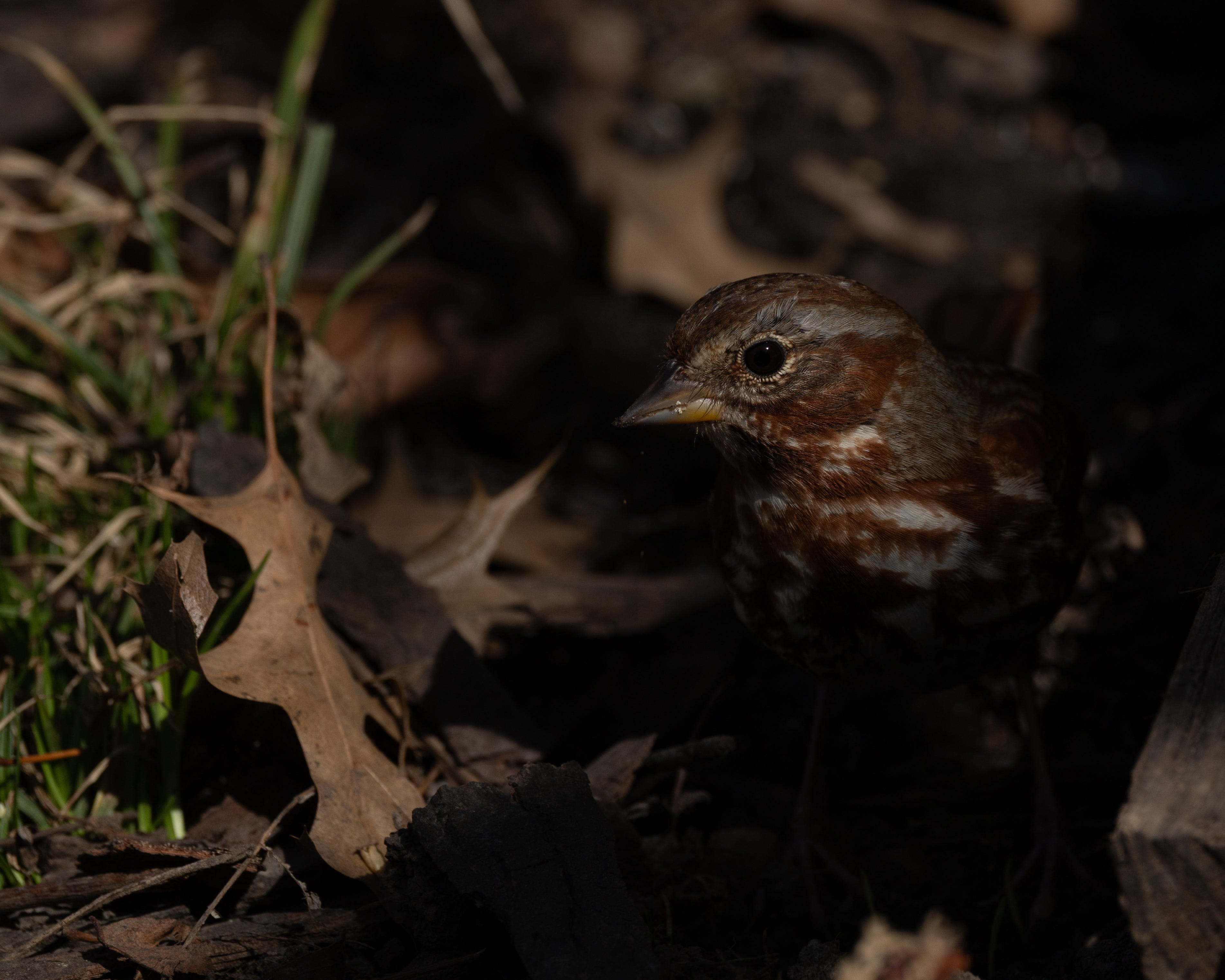
Then the Fox Sparrow turned and looked at me, his eye catching light, holding it. I closed my eyes. My attention drifted to the sound of the waterfall. I inhaled slowly and exhaled.
When I opened my eyes he was still there, still scratching, present in a way I had spent the whole morning trying to learn. And I imagined, or perhaps simply felt, that when he lifted from this yard and turned north, he would carry some of the restless parts of me with him. Not forever. Just far enough. Released somewhere into the wind and water, somewhere I will never see, somewhere the spruce trees hold the fog and the ocean fills the air.
And I would feel it, not all at once, not completely, but enough. Lighter. More free. Something in me briefly capable of flight.
The bird held my gaze a moment longer. Then turned back to the leaf litter and resumed scratching.
In that dark moment, something in me that had long lived in shadow finally felt at home. The Fox Sparrow was fully present, wild, at home. And for a moment, I was the same.
Each time I read your writing, I feel I have learned more from you about how to lose myself in nature, the most meaningful meditation possible. Your post about the fox sparrow may be one of your best from the standpoint of its poetry and its ability to draw us into your feelings. “A man undone by a sparrow…” What a memorable quote. You managed to help us feel vicariously undone by your sparrow, that common bird that you elevated so eloquently. Thank you.
What a beautiful essay on your encounter with the fox sparrow. You are a voyeur-yes- but perhaps also being watched by this seasonal migrant from north? Your captured images offer us intimate glimpses that are so rare- thank you! 🙏