
A Handful of Spring

Unspeakably I have belonged to you, from the first.
— Rainer Maria Rilke, Ninth Duino Elegy
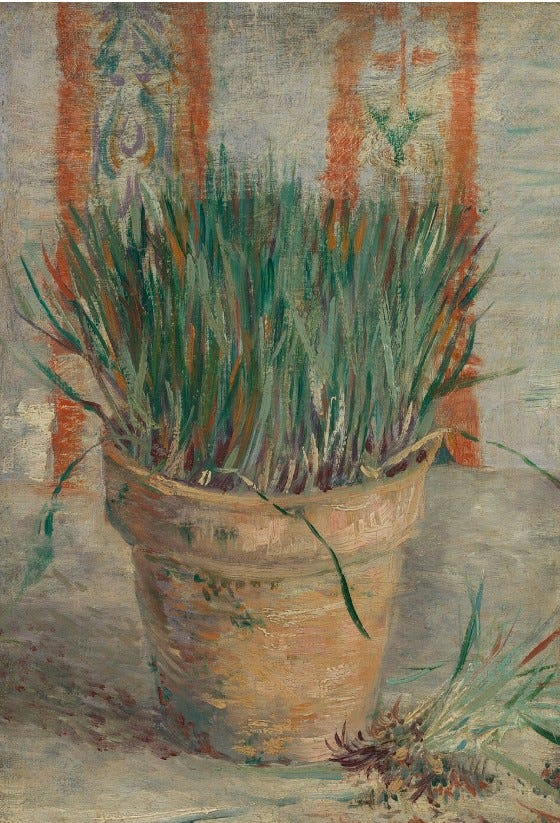
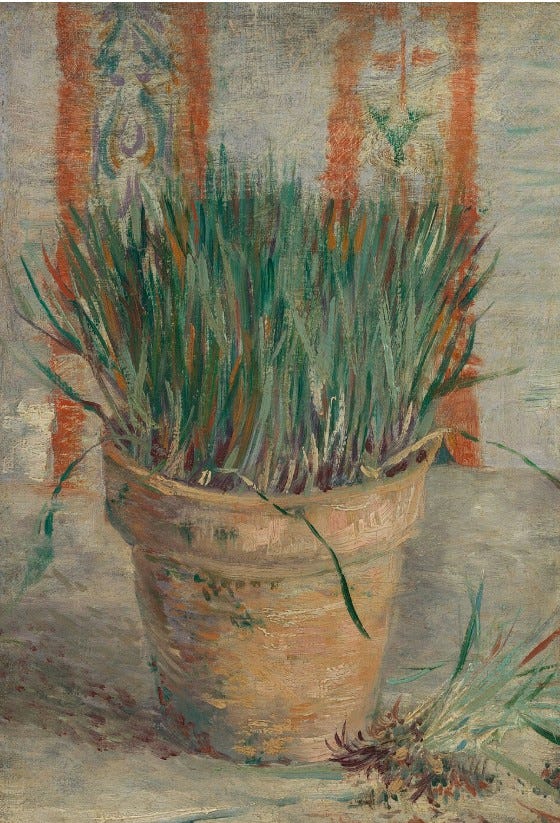
Vincent van Gogh spent an afternoon in 1887 staring at a small clay pot of garlic chives. He was thirty-four, living in Paris on his brother’s generosity, and he chose to give this common kitchen plant the same unhurried attention he would later give sunflowers and starry nights. The resulting painting is modest, a study in muted greens and the humble tan of earthenware. The chives aren’t doing anything dramatic. They are simply there, green and alive, and Van Gogh is simply looking.
The garlic chive painting is on display in the Van Gogh Museum in Amsterdam. Most visitors walk past it on the way to something more famous. I understand this impulse entirely. I have walked past the garlic chives in my own garden for years without stopping. They have returned every spring and slowly multiplied. It took me a long time to realize that this faithfulness, this showing up year after year, was inviting me into a relationship with sun, soil, and plant.
Earth, isn’t this what you want: to arise within us, invisible? Isn’t it your dream to be wholly invisible someday? What, if not transformation, is your urgent command?
— Rainer Maria Rilke, Ninth Duino Elegy
I gather a cluster of delicate garlic chive leaves in my left hand and sweep my knife through them. I suddenly smell a compelling aroma that makes me pause and take a deep breath. My nervous system responds with a jolt of recognition: yes, more of this. Mouth watering, my body falls into a rhythm. Hold, cut, bag, repeat. After a few minutes, I have a handful of spring.
Back in the kitchen, I wash and chop the chives as olive oil shimmers on the stove. I fill a jar with the greens and pour the hot oil over them. They sizzle, turning a vibrant emerald, infusing the fat with a sweet and slightly pungent brightness.
The chives were recently light. The plant took the sun’s steady electromagnetic stream, combined it with water and carbon dioxide, and made it complex and nourishing.
The sulfur compounds in garlic chives arrive in my system as medicine; they were assembled molecule by molecule over weeks, stored in the leaf until my knife releases them. Allicin, the compound responsible for that sharp, clean smell, doesn’t exist in the intact plant. It forms only when the plant is damaged, when two previously separated compounds, alliin and the enzyme alliinase, are ruptured from their compartments and meet.
The plant built this wound response over millions of years of co-evolution as a defense mechanism. But what the plant deploys as defense, the human body receives as nourishment. The plant used sunlight to make allicin; I am using allicin to make presence.
This is the transformation Rilke called an urgent command. The Earth does not want to be merely admired from a distance; it wants to arise within me, invisible. The garlic chive does exactly this. When I eat it, my body doesn’t just consume the plant; it continues the sunlight’s journey. Through the quiet fire of metabolism, I break those solar bonds and release that energy into my own nervous system.
A portion of the plant’s essence is then breathed back into the world. The carbon that was the physical structure of the leaf three weeks ago is now the invisible moisture of my breath, returning to the atmosphere to be gathered up again by the next green thing. The Earth has entered me, moved through my blood, and departed as spirit. The invisible arising is happening in my chest.
Come August, the garlic chive sends up tall stalks crowned with clusters of white star-shaped flowers, arriving late when most of the garden has gone quiet. Each flower head contains twenty-five to fifty-five individual blossoms, and chives rank among the most nectar-productive plants a gardener can grow, placing in the top ten in one survey of hundreds of common plant species, not for their fame but for the sheer volume of what they give. Bees come, and wasps, and skippers, drawn together by an abundance that arrives precisely when other sources are fading. But the nectar carries something more than sugar. The same sulfur chemistry the plant built as defense appears, at low concentrations, to help protect the bees from their own pathogens. The plant is dosing its pollinators. The gift goes deeper than food.
The garlic chive’s small angular black seeds are eager to spread. In the fall, heavy rains wash them across my yard and down the street. They settle into a crevice. A tiny ant finds a seed and performs the Herculean task of carrying the boulder back to its den. Along the way, the ant is attacked by a spider; the seed falls, sprouts, and grows, one thin green blade among a sea of grass.
This new sprout is one recent example of a reaching out that is part of four thousand years of faithful returning. Neanderthals were eating sulfur-rich alliums six hundred thousand years ago. When you eat chives from the garden, you eat the soil community, the bacteria and the fungal threads that have been in the ground as long as soil has existed. Your gut recognizes these organisms. Something in the immune system relaxes. Something in the serotonin pathway opens. The body that eats from the garden knows exactly where it is: what soil, what season, what light. The body that eats from a supply chain has no address.
If we surrendered to earth’s intelligence we could rise up rooted, like trees. Instead we entangle ourselves in knots of our own making and struggle, lonely and confused.
— Rainer Maria Rilke
I have come to see that tending to plants helps us tend each other. I see this most clearly in the men’s group I started. Once a month, we enter a sacred space through vulnerability, a glimpse of what it means to be an unfiltered man among men. We peek into the full depth of each other: the tenderness, the worry, the humor, and even the violence we are capable of. We hold these contradictions without flinching.
This is the true edge of the work of being human. Just as the garlic chive remains inert and scentless until its cell walls are crushed, we often carry our best medicine locked away behind the high walls of our own protection. It is only in the “moment of damage” — the rupture of our pride, the breaching of our silence, the admission of our capacity for harm — that the enzyme meets the amino acid. Only then does the sulfur transform into something that can heal. We release our most medicinal qualities, empathy, truth, and trust, only when we allow our protective layers to be breached. We do not gather to be safe; we gather to be transformed.
At our most recent gathering, our host Sam welcomed us into his rural home. We all proudly unveiled the beautiful food we had prepared for the occasion. The elaborate spread showcased our love for each other. The small glass jar of garlic chive oil I brought sat there amidst the splendor, modest and beguiling. We all gathered round and started serving ourselves, then we sat at the table and our conversation faded into the background as we started to eat.
The silence struck me most, not the coconut curry rice or the butternut squash mac and cheese, but the silence the food created. Eyes closed, silence enveloping, we were lost in communion. Gratitude slowly emerged from that quiet.
“This is so good,” someone whispered. And it was. The chive oil was passed around, and as it hit the warm food, the emerald green, captured sunlight of three weeks ago, shone on the plate, releasing its scent into the room once more. When the vibrant chives hit my tongue, the distance between garden and table vanished. In this green reality, the virtual noise of the world became irrelevant. We were no longer nowhere in particular; we were here, tethered to the season and to each other by the sharp, medicinal heat of the earth.
We finished our meal with oatmeal raisin cookies then headed outside into the dusk where we entered a grand cathedral of pines Sam had planted around his home. Robins by the hundreds were streaming in to roost in the shelter of dense green boughs. The robins enlivened the scene with flicking wings, pumping tails, songs, and loud “tut tut” calls. The trees shook under their weight. We stood in the fading light, surrounded by the robins settling in for the night, drawn together by an impulse for shelter.
Our men’s group functions like a node in a vast, invisible mycorrhizal network. The underground fungal web moves nutrients through countless small connections, each node giving what it has to its neighbor. None of us can see the whole network, but all of us are feeding it.
The following morning, I walked into my garden. The luminescent tips of garlic chives were reaching toward the dawn light. They knew I was watching them because they were watching me.
Recent research suggests that when you approach a garden, the plants already know you are coming. Not through sight or sound but through the electrical field your body generates. A five-year study found that plants produce distinct electrical signals in response to human proximity and emotional state, even before physical contact. The plant is reading you before you touch them.
When you kneel in a healthy garden, you are entering a field of biophotonic intelligence, a living conversation that our bodies have been fluent in for millions of years. The recognition you feel in the garden is mutual. The garlic chive has been reaching toward us for a very long time.
One way to join this ancient conversation is to plant garlic chives in a pot and admire them the way Van Gogh did, with total, unhurried attention, as if there were nothing more important in the world. In doing so you will discover something: you have a green thumb. The tuber provides insurance against neglect; this plant will outlast your forgetting, return despite your inattention, and meet you where you are when you finally come back to look. Let it multiply. Divide it and share it with someone who needs to start their own journey. This is how the gift has always moved, through a plant passed from one set of hands to another, across back fences and kitchen tables, for four thousand years.
In 1887, Van Gogh eventually set down his brush and walked away from the table. The chives kept growing.
“The body that eats from the garden knows exactly where it is: what soil, what season, what light. The body that eats from a supply chain has no address.”
This resonated deeply. Thank you. 🌱🪴🫶🏼
Beautiful, Bill. “When I eat it, my body doesn’t just consume the plant; it continues the sunlight’s journey. Through the quiet fire of metabolism, I break those solar bonds and release that energy into my own nervous system.” A stunning depiction of interbeing. ☀️🌱