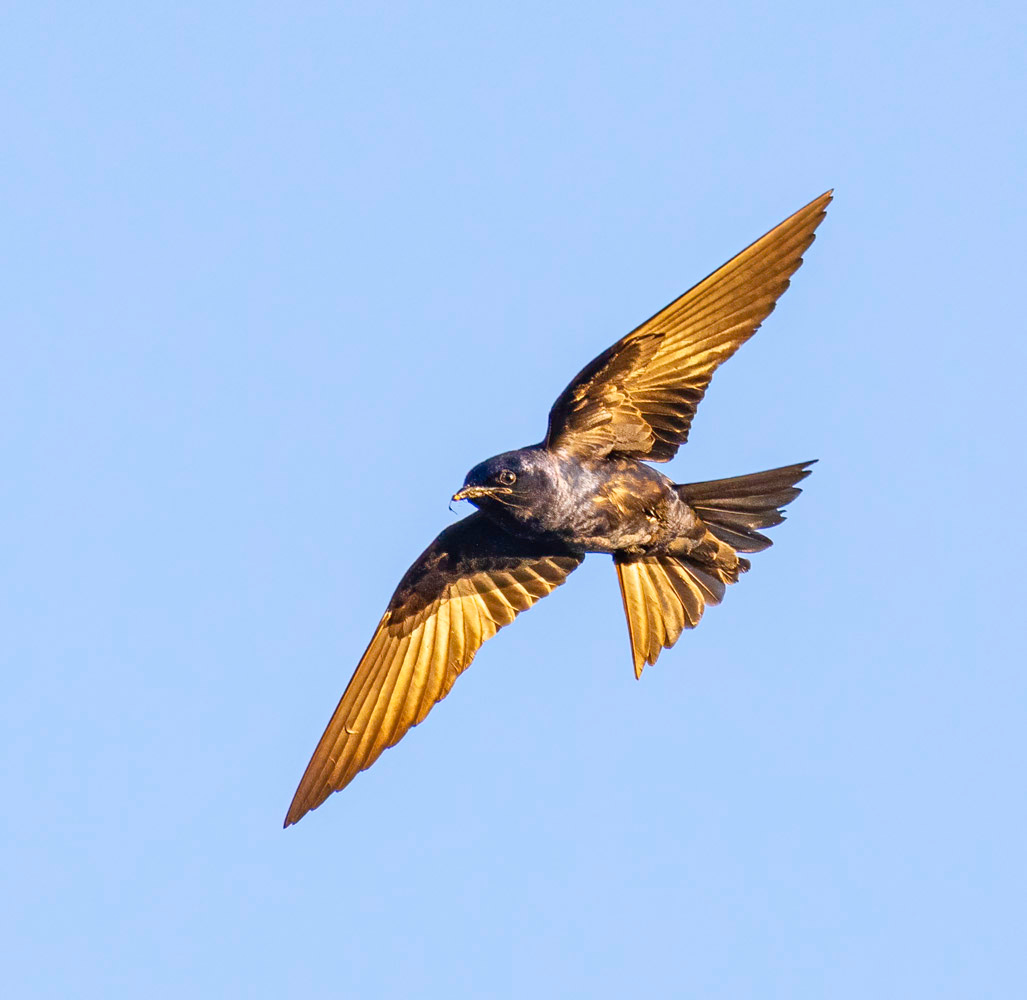
How to Save a Human: Notes from a Purple Martin Colony
We weren’t expecting company. Mercy and I were there for the inventory of life, clipboards in hand, ready to lower the nest boxes and record the secrets within. We had just begun the descent when Jim appeared, a silhouette drifting down the trail toward us.
“I know it’s your week,” he said, his smile sheepish, caught in the act. “I just thought I’d stop by. I couldn’t stay away.”
He was a week early, a man out of rhythm with the protocol but in perfect harmony with the birds. He was drawn back to the colony like the martins themselves—those loyal travelers who cross continents to find the exact celestial coordinates of a previous year’s nest. Above us, the birds performed their aerial circus, a kaleidoscopic display of swoops and chatters. The air was thick with their liquid warbles—a cascading, chattered grace that carries more weightless joy per note than any other sound in the Grand Prairie.
Jim wasn’t checking on us. He was here because he had felt the magnetic pull of the colony. He was here because the martins had begun their work on him.
When the Grand Prairie Bird Alliance first mapped these sites—the parks, the fire stations, the quiet corners of churches and schoolyards—we worried about the human element. We feared the weekly commitment of monitoring would be a burden too heavy for a distracted world. We framed our mission as a rescue: Purple martins are in trouble, their lives now almost entirely dependent on the wooden and plastic houses we hoist into the sky. We told ourselves we were the saviors, helping a species that had lost its way.
But we had the direction of the rescue backwards. The martins were about to show us what we were missing.
Instead of a struggle for stewards, we found a surplus of soul. Volunteers began checking twice weekly when we asked for once. They asked for more colonies, more poles, more weight to carry. Last season, 121 pairs nested across our sites; this year, we hope for 150. In our community, the limiting factor isn’t the will of the people—it’s the speed at which we can build.
The martins are tending to us. They are teaching us the art of the molt—how to let go and shed the dry skin of our screen-mediated existence and our privately nursed anxieties. They are calling us back to an embodied presence, pulling us out of our separate houses and into a shared, messy vitality.
It has to be dark to see the stars. Similarly, our screens must go dark before we can see the light of the living.
I remember a woman who stopped at the park colony on a June afternoon. She stood in the grass as the martins dove and spiraled in a frantic, beautiful geometry overhead.
“I’ve always been attracted to nature,” she said, her eyes tracing a bird’s trajectory against the blue. “I wanted to be an artist. I love birds. But life... life took me in a different direction.”
As the martins chattered their cooperative songs, her own story began to spill out. The birds made space for it. By going about their purposeful, communal lives, they gave her permission to voice what was true. In that moment, she had allowed the digital glare to fade, and in that newfound darkness, her old dreams became illuminated once more.
Purple martins nest in colonies by choice, not necessity. They huddle together in high-rise apartments, dozens of families in a chaotic, shimmering proximity. It is not a peaceful life if peace means silence; it is a riot of sound and communal defense. But this is what peace actually looks like: not a curated calm or a lonely withdrawal, but the vibrant, difficult, and glorious work of relationship.
When Jim shows up on “our week,” when a stranger lingers for thirty minutes to talk about art and loss, the martins are working on us. You cannot monitor a colony through a glass screen. You must be there, feet in the clover, hands on the pole, looking up. When the illuminated rectangle in your pocket goes dark, the world finally lights up.
Our colonies are spreading now—churches, schools, the horticulture center. Each site is a place where old, dead forms of isolation fall away and something new becomes possible. I can see the future in these sites: a child at recess, phone forgotten, eyes fixed on the sky; a firefighter stepping out between sirens to watch a life that doesn’t burn; a community learning, note by liquid note, how to be alive together.
The screens offer us connection without commitment—a constant, artificial glow that ensures we never have to sit with the dark. But the darkness is where the stars live.
If you bring purple martins to your community, do not think you are signing up to help the birds. You are signing up to let them help you. They will need your housing and your protection, yes, but what they really want is your presence. They are asking you to let the artificial world go dark so you can see what is actually radiant.
Each April, they will return from Brazil, trusting that we will be waiting. They will fill the air with their demonstration of what it means to be at peace with dependence and community. They are coming back to remind us of the stars we’ve forgotten to watch. All we have to do is show up, and let the martins do their work.


What perfect synchronicity--that this morning I drew the "Purple Martin" card, randomly, from Maria Popova's Almanac of Birds, and then open my laptop to your own witness of these "human-saving" birds. Together, your vibrant definition of Peace, and hers of Hope's tenacious imagining, bring me courage for this day.
Thank you, Bill!
“They are asking you to let the artificial world go dark so you can see what is actually radiant.“
😍