
Soft Eyes

The first time, I was pruning the pear tree at the back of my garden immersed in thoughts about which branches to cut and which to spare when a sound brushed through the morning and vanished. Faint, twittering, over before I could turn toward it. I stood still for a moment, pruners open. That sounded like a woodcock, I thought. Then I returned to my work.
The following spring I was working in the back of my garden again pruning black raspberry canes that trail along the garden’s edge. It was a windy day. The trees shook, the canes swayed, the whole garden heaved with an ambient rustle. I was moving through the leaf litter at the base of the canes, head down, when the litter erupted beneath my feet.
Not a polite departure, but the sudden violent flush of a bird that had crouched perfectly still until the last possible moment, launching itself upward with a burst of fast-twitch muscle and rounded wing. And then a sound threaded through the wind: a rapid, mechanical twittering, like a tiny wheel spinning. I turned, scanning the sky. A flash of movement, a freeze-frame, a tawny shorebird the size of a large fist banked past me through the oak branches, close enough to see the long bill and the compact body built for exactly this: the explosive departure and the disappearing act. And then she vanished.
The second flush did what the first hadn’t quite managed: it cracked me open. It left me standing in the March wind full of questions. Where had she come from? What had drawn her to this particular patch of ground? And why, for two springs running, had she chosen mine?
The American Woodcock, Scolopax minor, exists as a creature literally turned upside down by its devotion to the world beneath its feet. Technically a shorebird, it abandoned the coastline eons ago for the forest floor, and its body has been radically rearranging itself around that decision ever since.
Consider the physics of her shape. To the casual observer, she appears as a plump, neckless orb. A feathered brown ball of a bird. But that roundness functions as a highly specialized engine. Because she must launch six ounces of weight vertically through a dense thicket of branches, she possesses massive pectoral muscles packed tightly against a deep keel bone. This compact center of gravity allows for the fast, low-altitude maneuvering required for a forest life.
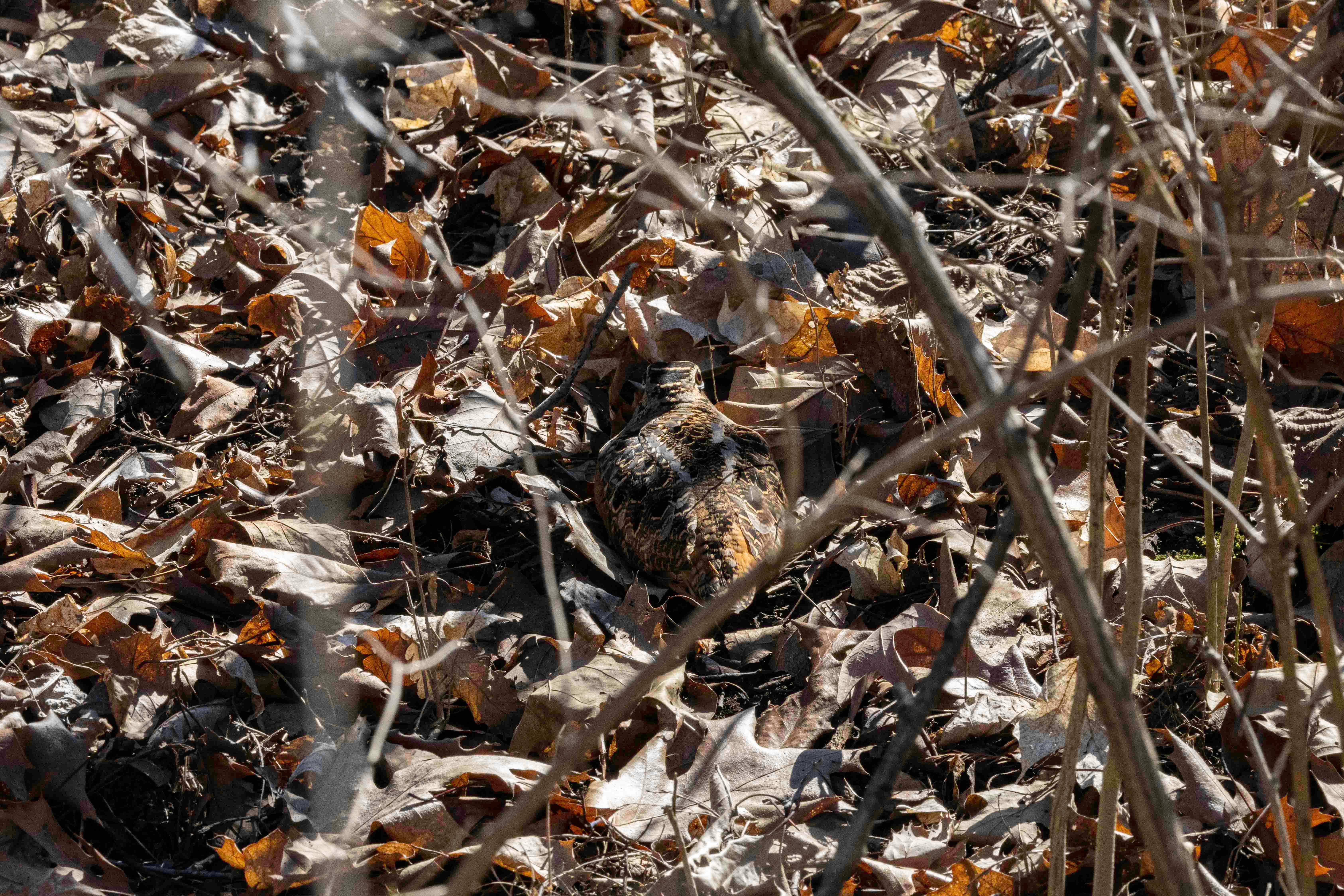
She lacks a visible neck not because she is short-stemmed, but because she carries her cervical vertebrae in a permanent, tucked S-curve against her chest. This hunkered posture, combined with a dense layer of down feathers that trap heat against the damp March mud, erases the visual break between head and body. She materializes in the leaf litter not as a bird, but as a soft-edged mound of forest debris, a master of disruptive camouflage who uses her own bulk as a counterweight to drive her bill into the soil.
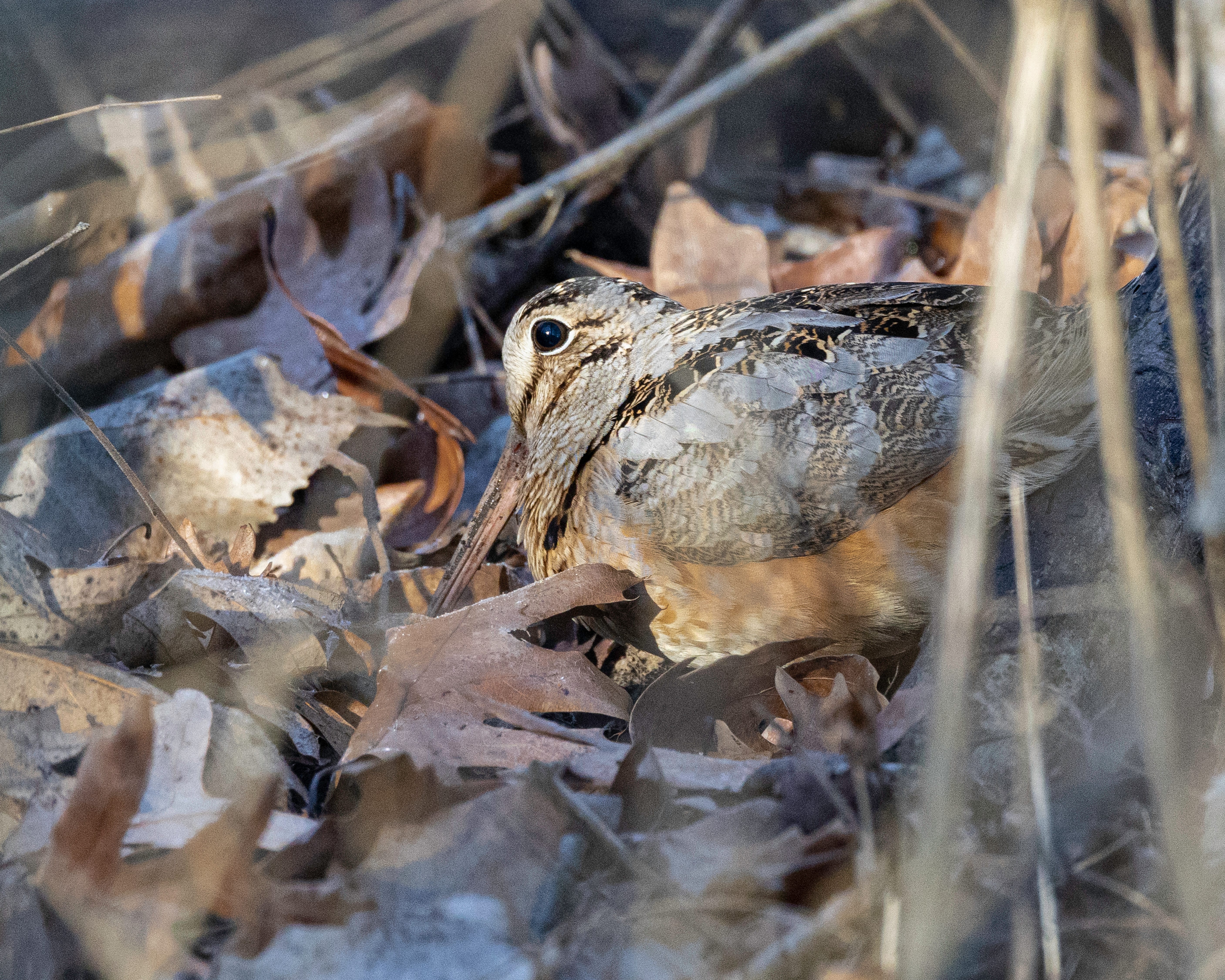
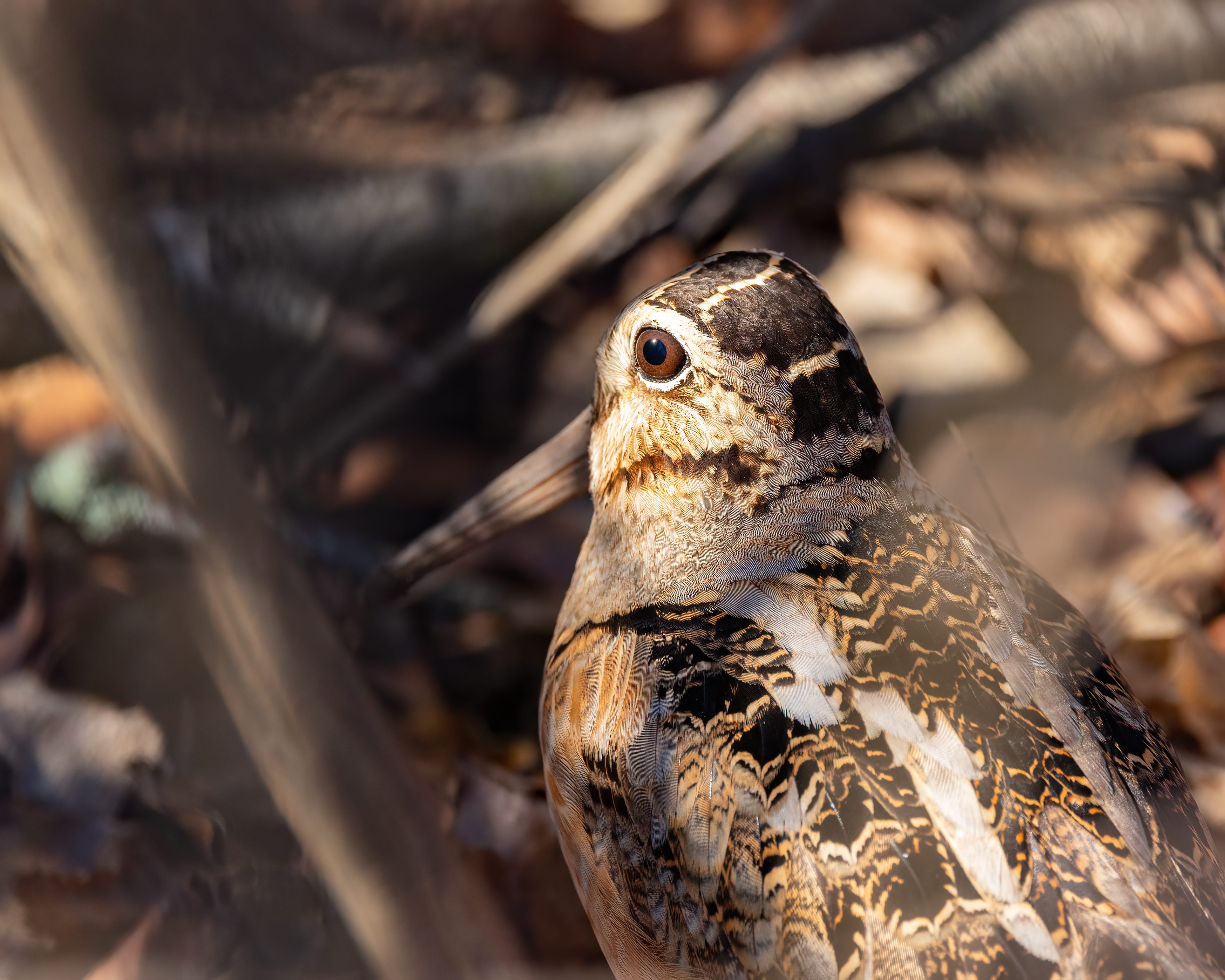
Evolution migrated the eyes back and upward, to the very crown of the skull, granting a near 360-degree horizon. This allows her to scan for danger above and behind even while her bill probes for worms. The ears followed, moving forward between the eye sockets and the bill to better triangulate faint tremors in the soil. Even the brain, displaced by this sensory migration, rotated inside the skull until the cerebellum sits inverted from the position it occupies in virtually every other bird on earth.
The woodcock inhabits a threshold, its body in the March light, its bill reaching into the invisible world of root and mineral and slow decomposition. The bill functions as a bridge where those two realms meet. The appetite this instrument serves staggers the imagination; a woodcock can eat its weight in earthworms every single day, the equivalent of a 180-pound person consuming 360 meals in a day. It is a level of consumption that would trigger a medical emergency in most other species, but for this feathered beach ball with a face-needle, it represents just another day in the life of a Woodcock. She operates as an eating machine of almost comic efficiency. A round, solemn bird spending her crepuscular hours stitching her bill into the mud with the frantic intensity of a sewing machine, reading the darkness and pulling up sustenance.
My neighbor’s lawn, chemically fertilized, annually shorn, the leaves blown away, presents, from a woodcock’s perspective, a desert. My garden, by contrast, pulses with slow decay: years of compost, and wood chip mulch. I created exactly what a woodcock needs. I just didn’t know, until that second March morning, that I was making it for her. I was witnessing abundance calling to abundance. This governs the living world as one of its quieter laws: that what you tend with patience and care will eventually call in something you never planned for, something that recognizes what you’ve built before you do.
After my garden encounters, I started noticing woodcocks in a city park a few blocks away from our house. I was birding the trail in my usual way, moving at a walking pace, scanning the canopy, when I began hearing that mechanical twitter. A flush, a glimpse, and then silence. It happened several times over several weeks: the bird departing before I had fully arrived.
One day, I turned off the main trail onto a narrow path. I slowed down. I stopped every few steps. I scanned the leaf litter, not sure what I was looking for, knowing only that the birds waited there. Eventually, I realized that my version of slow still clashed with the pace of a creature that lives by the pulse of the earth. So I slowed further. Two steps. Stop. Scan. The pace of someone learning to be still.
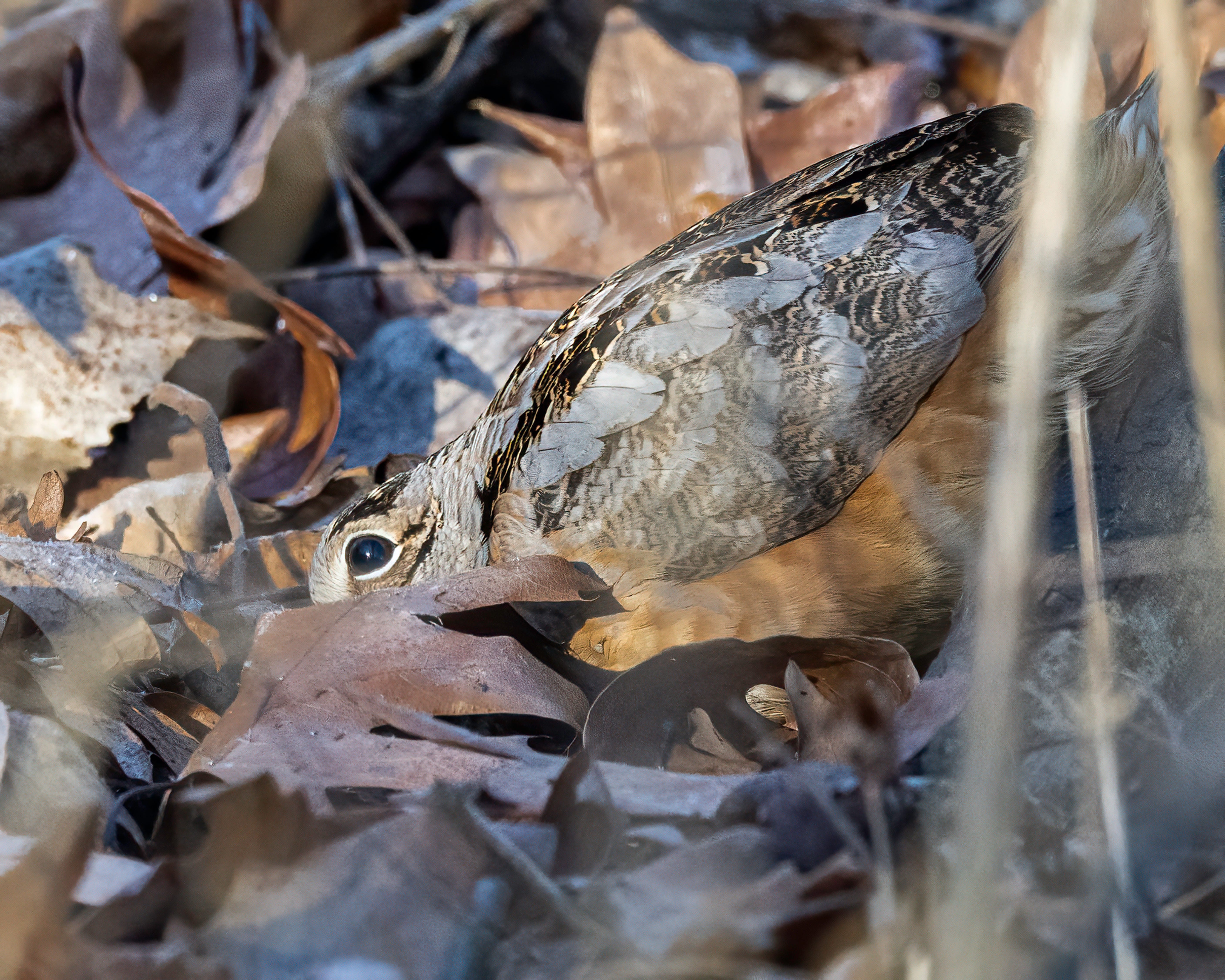
Gradually, the forest floor began to assemble itself. I began to develop a search image. It begins with the eye: one soft, dark orb catching the light in a way that dead leaves don’t. Then the bill, long and incongruous, lying against the tan and brown. Then, slowly, the whole bird crystallizes, the body and the leaves so unified that to see one is to see both at once.
But seeing was only part of it. The woodcocks were reading something beyond my pace, they were reading my nervous system. A tense body moves with an agenda; a relaxed one moves with an invitation. The work evolved into a settling of the self before entering the trees, so that what walked into the woodcock’s world was not a predator on an errand, but a presence without a destination.
My most recent encounter unfolded as a quiet conversion. I was slowly threading my way through thick brush when I stopped, and to my right, perhaps four feet away, I heard a soft rustling. Not a flush, but a footfall.
I looked down.
A woodcock materialized there, picking its way through the litter with that ancient, rocking walk, its body swaying forward and back as if it were feeling the earth’s pulse through its feet. She stopped and looked at me. To be seen by a woodcock is to be judged by a standard that has nothing to do with human achievement. She wasn’t looking at my credentials; she was reading the frequency of my pulse.
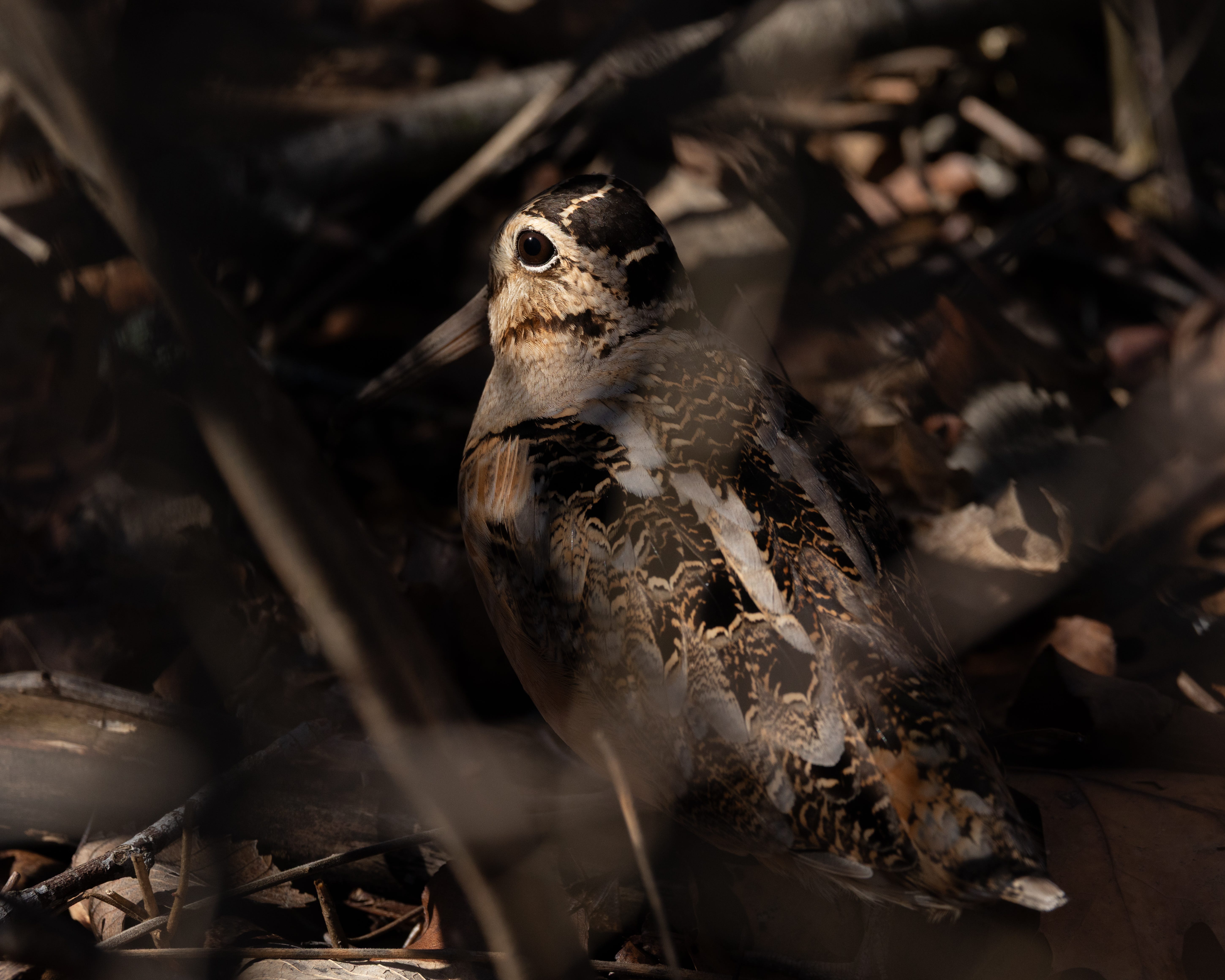
I stood transfixed. There was no sound, nothing but those enormous soft dark eyes fixed on me, that slow dance, the leaves shifting almost imperceptibly around her feet. The woodcock’s gaze was magnetic. I felt myself drawn downward — into the leaves, into the faint fungal smell of the turning earth, into the invisible world of mycorrhizal threads and worm castings that make everything above them possible. We were standing at the same threshold, looking at each other across the seam. A silent symphony, holding its own.
After a long moment, she turned and walked away, unhurried, into the undergrowth. I stood still until she was gone, then walked on, slowly, looking at the leaves.
There is a cost to this, and it is worth naming. To cultivate soft eyes is to lose the protection of the narrowed gaze. When you stop looking at the world as a resource to be managed, and allow yourself instead to be looked at by the world, you step into a profound uncertainty. You walk away from the order that tells you a bare lawn is a virtue and a fast pace is a sign of purpose. You become, on your street, the person who hears the earth talking and knows that most of his neighbors have forgotten the language. This is not a comfortable place to stand. But it is a true one.
Most of us keep blowing the leaves away. Not from malice, but because the association runs so deep it operates below the level of choice. The bare lawn represents order; the leaf-covered ground registers as a failure. It is a groove worn into the brain by decades of repetition, a synaptic pathway so well-established that it registers as a felt sense of rightness.
But grooves can be recut. New associations form through repeated exposure, focused attention, and the reward of noticing something that matters. When we deviate from an established pattern, the brain signals discomfort. The neighbor’s raised eyebrow signals a new groove being cut. There is a specific, quiet rebellion in standing on your porch, coffee in hand, and intentionally watching your property go to seed while the rest of the street engages in a gasoline-powered war against the seasons. You have to be okay with being the neighborhood’s cautionary tale — the guy who works in agroforestry but apparently can’t find his rake.
I’ve come to see that the leaf litter serves as the roof of a vast, subterranean city. When we blow the leaves away, we unroof the neighborhood. We strip the cover from the burrows and the fungal threads, leaving a world of delicate architecture standing bare under a harsh sun. We turn a home into a hallway. Your brain adapts to the silence. But the real cost resides in the grief that arrives when the desert of the treated lawn no longer feels like a choice, but like a wound.
Start with a corner. Leave the leaves. Notice what moves in. Each time you walk past and choose not to rake, you anchor new circuitry. The external landscape and your internal landscape expand together, until the leaf-covered ground begins to feel not like neglect but like belonging.
The woodcock offers a glimpse of what it looks like to inhabit a life completely. Soft eyes. And something more than soft eyes — an entire body reorganized around receptivity, around the willingness to receive what the world is already saying. Including what it says underground, in the dark, below the threshold of human hearing.
The soil is not silent.
Earthworms moving through their burrows generate acoustic waves conducted through wet earth, registering in the Herbst corpuscles of the bill as pure vibration and information. The underground world hums in constant conversation with itself: root and fungus and worm and beetle, exchanging signals in a medium we walk over every day.
When the woodcock rocks its body and steps heavily on the soil, it is not simply stirring up prey. It broadcasts a signal into that conversation and waits for the response. Call and answer. It functions as a conductor tapping the podium — and the orchestra is the earth itself. The woodcock’s entire body evolved as an instrument built for one purpose: to be fully inside that conversation. Not observing it. Not managing it. Conducting it and being conducted by it simultaneously.
The symphony persists. It has never stopped. The soil beneath your feet right now, under the leaf litter you left this past autumn, thrums with sound you cannot hear but can, perhaps, begin to feel, if you go slowly enough, and stay quiet enough, and press close enough to the earth to let it reach you.
To move through the world with soft eyes is to feel the dance again. To be free in it, and easy, and at home — not despite the hardship that life also contains, but inside it, alongside it, the way the woodcock navigates a drying landscape, drawn to leaves, finding what it needs, persisting.
Go slowly. Look at the leaves. Leave them where they fall.
The woodcock waits, already listening.
This may be the most beautifully composed piece of writing I have ever encountered! So much information given, so many actions explained, an amazing job of teaching as well. Wow.
Thanks Bill for this piece. What I love most here is how observation becomes transformation. This is the kind of writing that doesn’t just inform, it recalibrates.