
The Soft Song

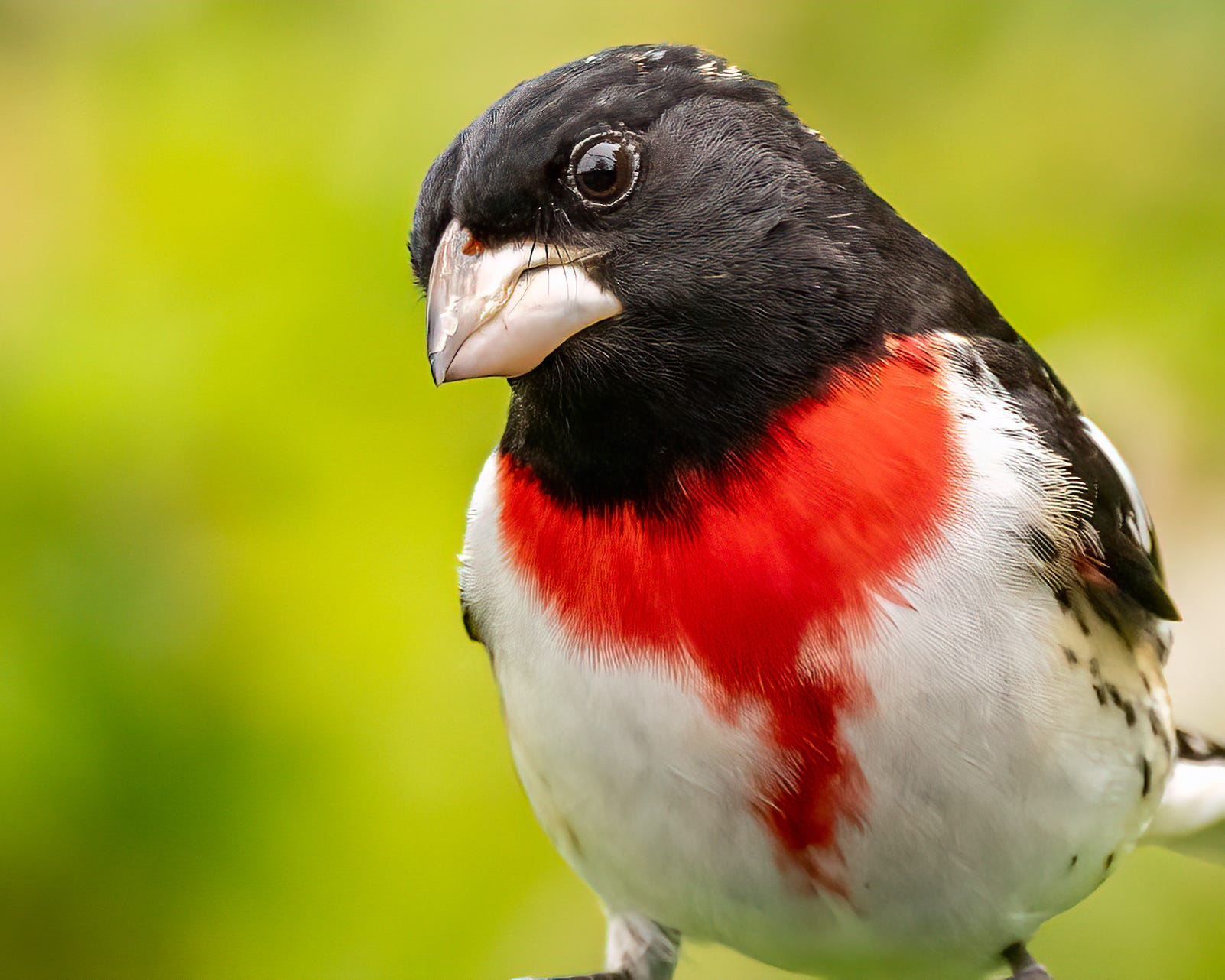
The asparagus spears snapped in my hands. Then, the sound: a squeak of shoes on a gym floor, sharp and unmistakable, falling from the canopy of the Silver Maple. A Rose-breasted Grosbeak.
I scanned the leaves on the walk back to the house. I hoped it would not be long before I caught a glimpse of him.
I stood inside watching. Sparrows came and went. Then a black-and-white flash disappeared into our Jonathan apple tree, and everything went still. A few minutes later a black head with bright eyes emerged from the leaves. I backed away from the window. The grosbeak observed the feeder for a long minute, conducting the ancient heavy weighing of risk and reward, then dropped onto the perch.
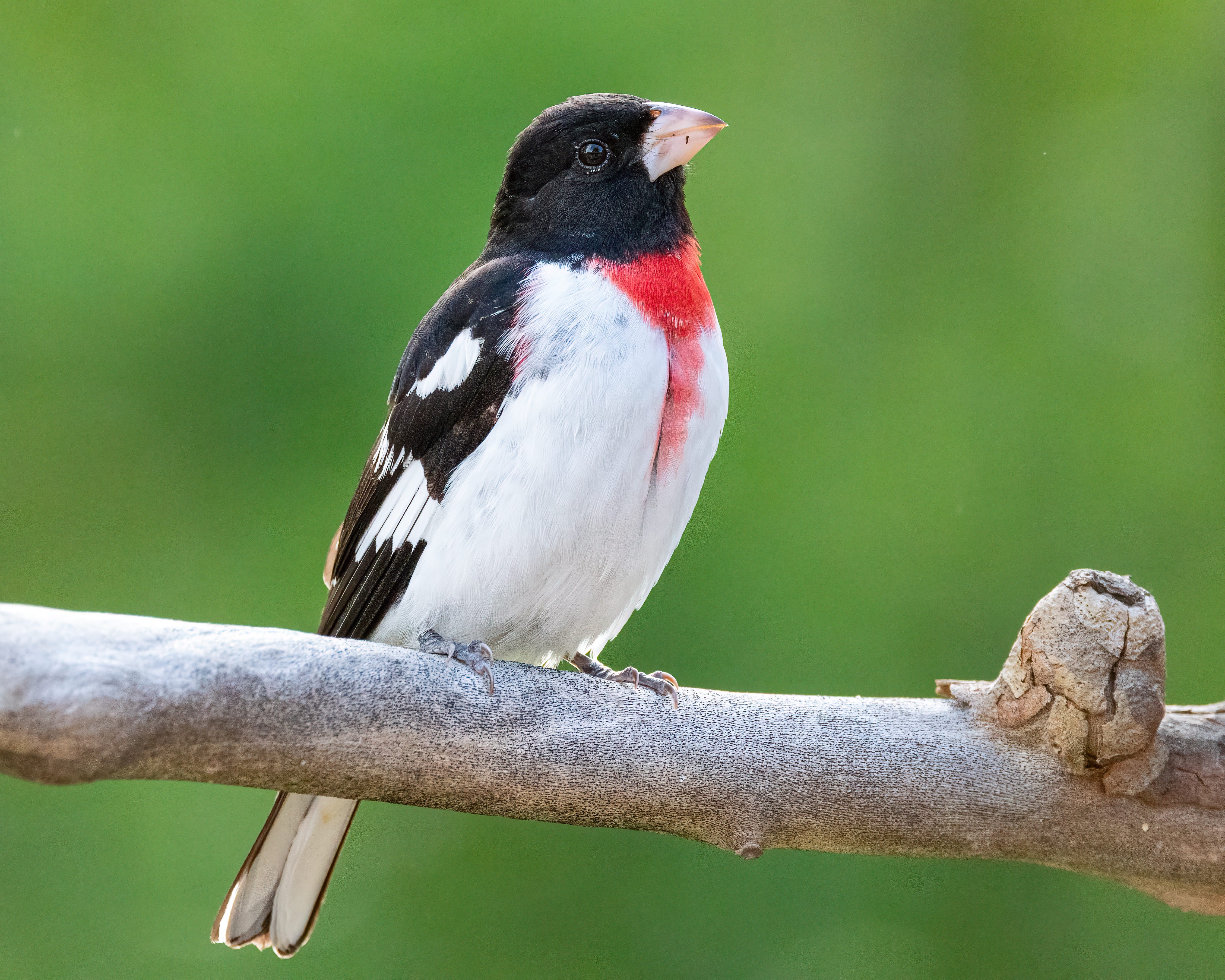
I went to the sliding door and stood behind the screen. Every line on him was sharp. The black of his hood, the white of his shoulder, the rose triangle laid on his chest like a brushstroke. And yet he was content and soft at the edges of his own boldness.
Then I heard his subtle calls, barely audible at ten feet. Who was he calling to? There was no other Grosbeak in the Maple that I could see. To my ear his calls conveyed contentment. The long flight from central or south America is over. An abundant food source was found. After a few minutes of eating sunflower seeds he flew back into the canopy and commenced his warble, which sounds like a Robin that has trained for the opera.
Six seconds. Twenty notes. He broadcasts it from the highest perch he can find, again and again, six or seven hundred times in a single day. Between phrases he gives that sharp chink, the gym-floor squeak, the punctuation that tells you he is still up there even when the warble pauses for breath.
This is the song that fills the field guides and the wonder of anyone who goes to the May woods with an open heart. This Grosbeak has recently crossed the Gulf of Mexico in a single night, in a pulsing feathered body that weighs about as much as a slice of bread, and he is announcing his arrival to a continent.
How is it possible that a heart, no bigger than a pearl, keeps its rhythm over a thousand miles of salt spray, wind, and waves? I ask this question every spring and never tire of the not-knowing. How does a bird this small carry that voice across a thousand miles of dark water and arrive at my apple tree with the song still in him.
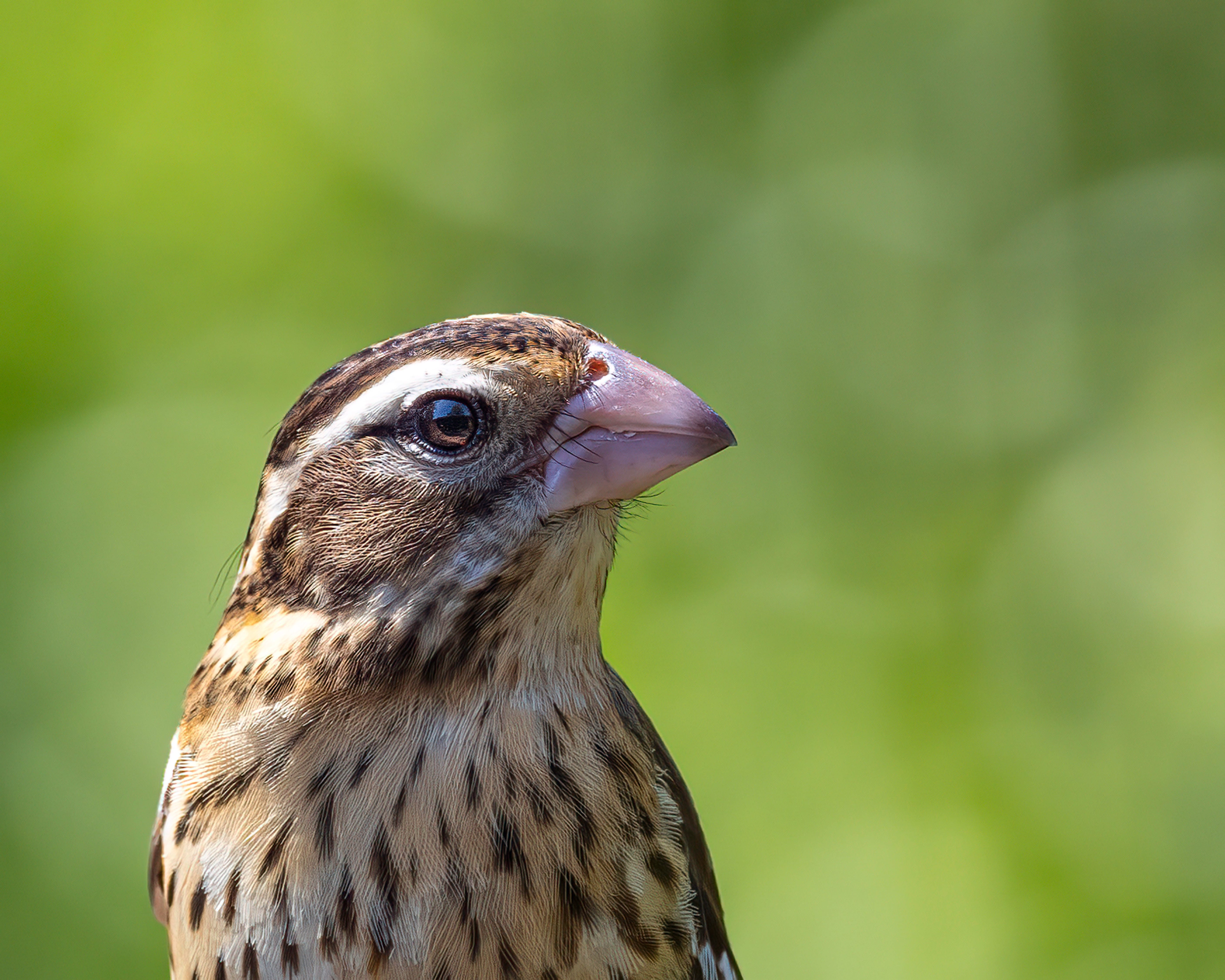
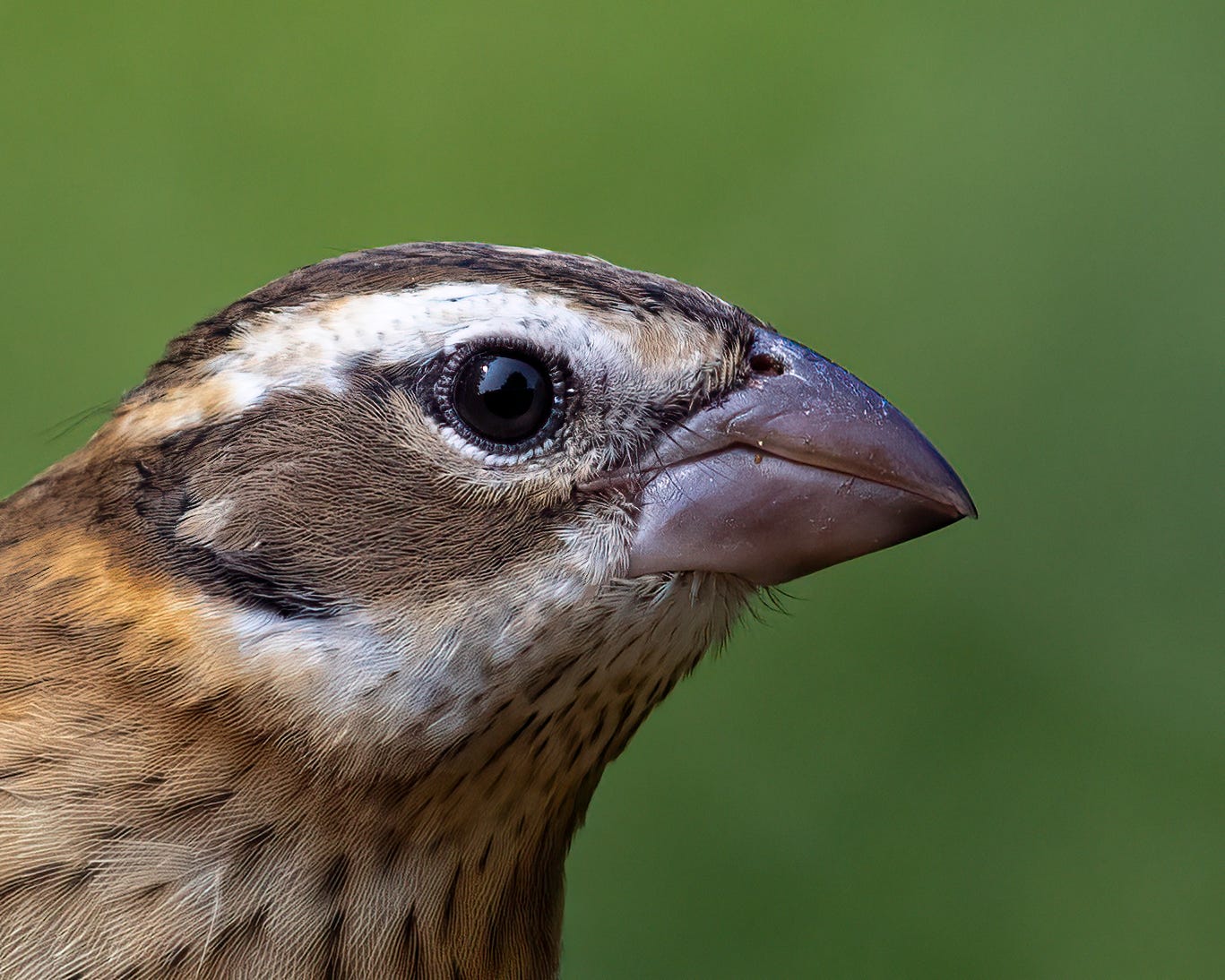
The female will arrive in a few days, brown-streaked and quieter, easily mistaken for a sparrow by anyone not paying attention. She has flown the same gulf. She has the same strong beak, the same bright eye. What she does not have is the rose chest, and so for a long time we did not look at her closely enough.
They will choose a sapling fork together, six to twenty-six feet up, in second-growth woods. They will weave a cup of twigs and grass, and they will weave it loosely. So loosely that the eggs are visible from the ground below, through the bottom of the nest. A bird famous for the bold flag of his chest and a melodious song builds a nest you can see through.
Three or four speckled pale blue eggs. Both birds incubate. The male takes a turn for several hours during the day. The female covers the rest, and all the night. Several times a day they trade places. And when they trade places, both of them sing.
Not the canopy song. A different register. The same warbling phrases, but quiet, sometimes with the bill closed, audible only to a listener standing very near. The ornithological literature, having reached for a word and found nothing else that fit, calls it a soft song.
The female sings too. She sings the same warbling phrases as the male, in the same soft register, at the handoff and during nest-building and in moments we have not fully catalogued because we have not, until recently, been looking.
Her soft song is the sound of the world being put back together. It is the low humming of the earth itself. The secret language of those who know they are already home.
The duet at the nest exchange, the quiet warble between mates over a flimsy cup of twigs, has been happening every May and June since long before any of us were here to listen.
It is happening right now. Two birds, whispering to each other, shaping their world around a handful of speckled eggs.
The loud song from the canopy defends a perimeter. The soft song from the nest builds the world inside it.
The hard register makes room for the soft register. The bright chest flashes so the eye is drawn upward, away from the cup of twigs in the sapling fork where the actual life is being lived. The whole architecture of the bird is in service of the soft thing at the center.
Watching him, I think of what the old Chinese sages called the valley spirit. The low place where water gathers, the empty bowl that holds the meal, the dark mother from which everything comes and to which everything returns. They meant the feminine as the older thing, the deeper thing, the receptive ground in which the active world is rooted. The valley spirit, Lao Tzu wrote, never dies.
I think the grosbeak knows this in his small body. He sings the loud song from the high place. Then he comes down to the sapling fork and sits on the eggs and sings the soft song with the bill closed. He carries both. The bright chest and the patient sitting. The territorial warble and the quiet duet. He is undivided.
And so is the female. She incubates the eggs and warbles softly to her mate at the handoff and rises every spring to make the long journey north. The receptive and the active, in a single body. Each of them is the valley and the mountain at once.
Which means each of us is too. The bright outward life is also the patient inward one. We have been told for centuries that we must choose, that the strong is one thing and the soft another, that the masculine builds and the feminine tends. The Grosbeak does not know this story. The Grosbeak is busy being whole.
The small delicate birds face great obstacles, yet never lose faith in the song. They just keep singing the soft song. And eventually, over many seasons, something gives.
I have spent so much of my life being the hard thing. I have gripped the world until my knuckles turned white, forgetting that the nest is woven loosely for a reason. I am trying to learn what the bird already knows. The way through is soft. The way through has always been soft.
There is a darker thread in the bird’s story. On the wintering grounds the Rose-breasted Grosbeak is sometimes trapped and sold as a cage bird, because he is beautiful, because his song is beautiful, because we want to hold what we love.
The bird in the cage loses much, but he keeps his song. He sings it from inside the cage, and the song does what songs do. It carries across the room. It slips through the open window. It crosses the courtyard and reaches a tree where another bird is listening. It joins the larger conversation that has been going on in every grove and garden since long before there were any cages. The cage cannot hold the song. The song goes where soft things go, which is everywhere, through every crack, into every ear willing to receive it.
And so I stand at the screen door instead of reaching for him. The bird in the maple is giving me the song the way the song wants to be given, which is freely, into the air, with the maple and the woods and the female on her way north and the long history of May behind it. I want to be the listener whose hands are soft and open.
This is what I am meant to learn from him. Our lives are held the way those speckled eggs are held. By a net of relationships. By threads we can see through. By the soft songs we sing without quite knowing we are singing. Ben playing the cello. Noah making cookies. The way Mercy hums in the next room while the windows are open. Me cooking dinner. These are the soft threads the day is woven from. Without them, relationships falter.
The soft song crosses the walls of our houses and the borders of our nations and the partitions of our offices and the fences we build to keep one another at a manageable distance. It moves through them all. The hard structures look permanent, but they are not. The soft song has been crossing them the whole time. It is how we know one another at all.
I rinse the asparagus as the warble carries through the screen. Somewhere in the woods a female grosbeak is on her way north, brown and quiet and full of song. The world is not hardening. The world is opening, the way it does every spring.
Through the cracks, softly.
Our whole world needs to embrace the soft songs now. Thank you for this beautiful musing. It made my morning!
Ah such melodious speech...I seem to hear the cadences of your voice coming through the written screen. These pieces move me so much, I am going to print them. Even though I have never beheld or heard this lovely bird..thank you.