
The Widening Net

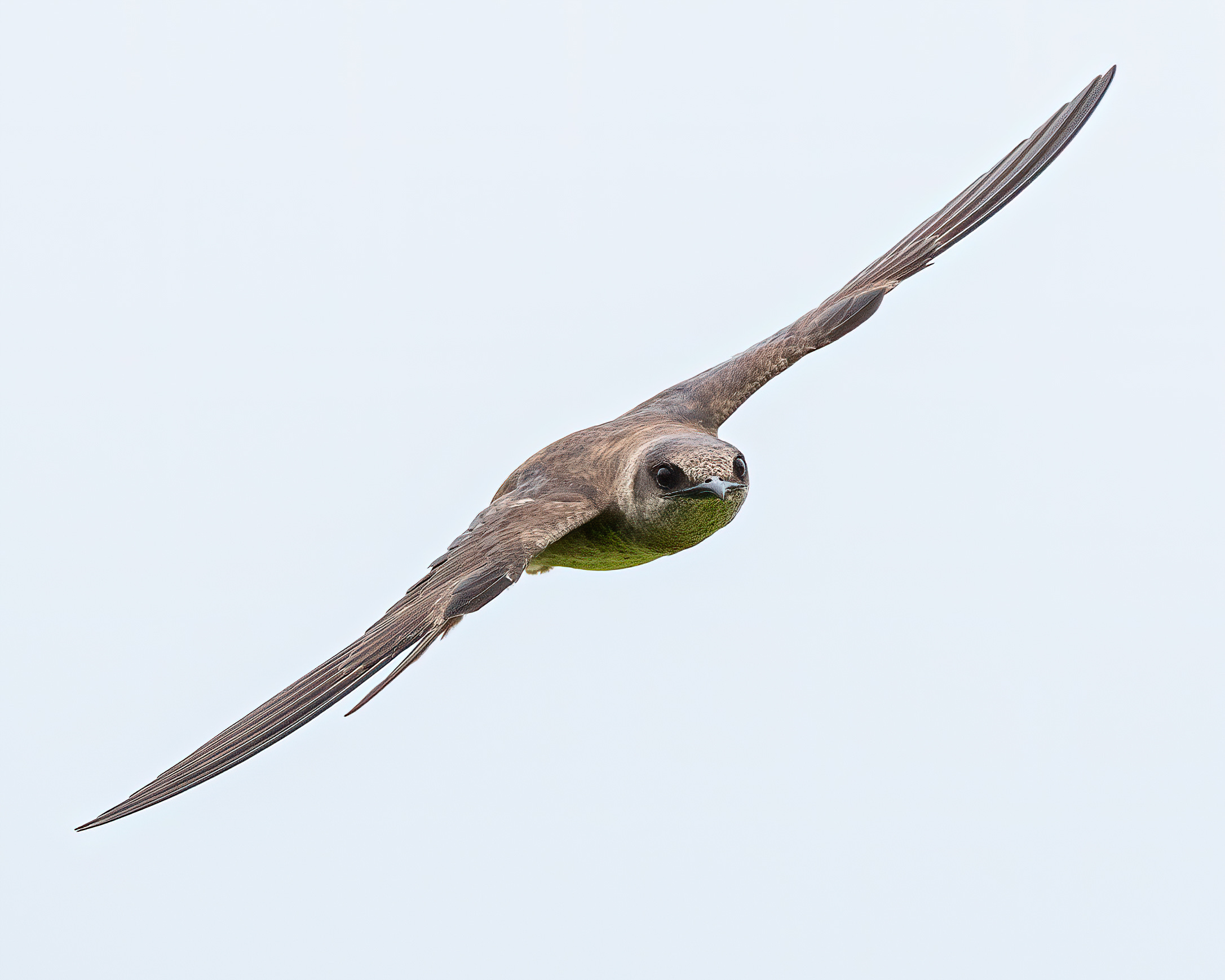
As the Martin House slides down the pole, the air fills with a purple cloud, birds swirling above drenching us in liquid warbles and down-slurred whistles. Then Mercy stops turning the crank and the box comes to rest.
Mercy and I have been Purple Martin landlords for this twenty-four-compartment house for a couple of years now. It stands with two other Martin houses in a restored prairie on the edge of an urban lake, where a walking trail passes close by.
Before we start, a broken piece of a dragonfly catches my eye on the ground, dropped or spilled from the box above. I pick it up. It is a fragment of the head, mostly a curved dome of eye packed with thousands of facets, tiny lenses side by side, each its own window. Each known as an ommatidium.
I turn the dragonfly eye in the light and a rainbow flashes across it, sliding over the thousand faces as I tilt it, green to gold to a wet blue. I look up and the Martins are wheeling above the box, their flight tracing small circles that expand and open loop over loop into the morning.
We begin counting eggs and nestlings and noting their age. It is harder than it looks. The cavity is small and dark; the nestlings hunker down into the nest; grass stems cross in front of them. Sometimes it is hard to tell how many are in the nest.
As we finish one side of the box we notice a family with young kids walking down the trail. Mercy calls out: “Would you like to see some baby birds?”
A curious young boy and a girl run over, phones in their hands. Mercy cranks the box a little lower so they can see in. They lean toward the opening and then I hear, “They’re so tiny,” and, “This one is trembling. Why is he shaking?” They begin to move around the box, following Mercy from compartment to compartment, looking in at eggs and nestlings at every stage. At the next opening the little girl leans in, sees three-to-four-day-old nestlings, and exclaims, “They’re naked!” The phones are in their pockets now. The grandparents have come up behind them, standing close, watching, smiling.
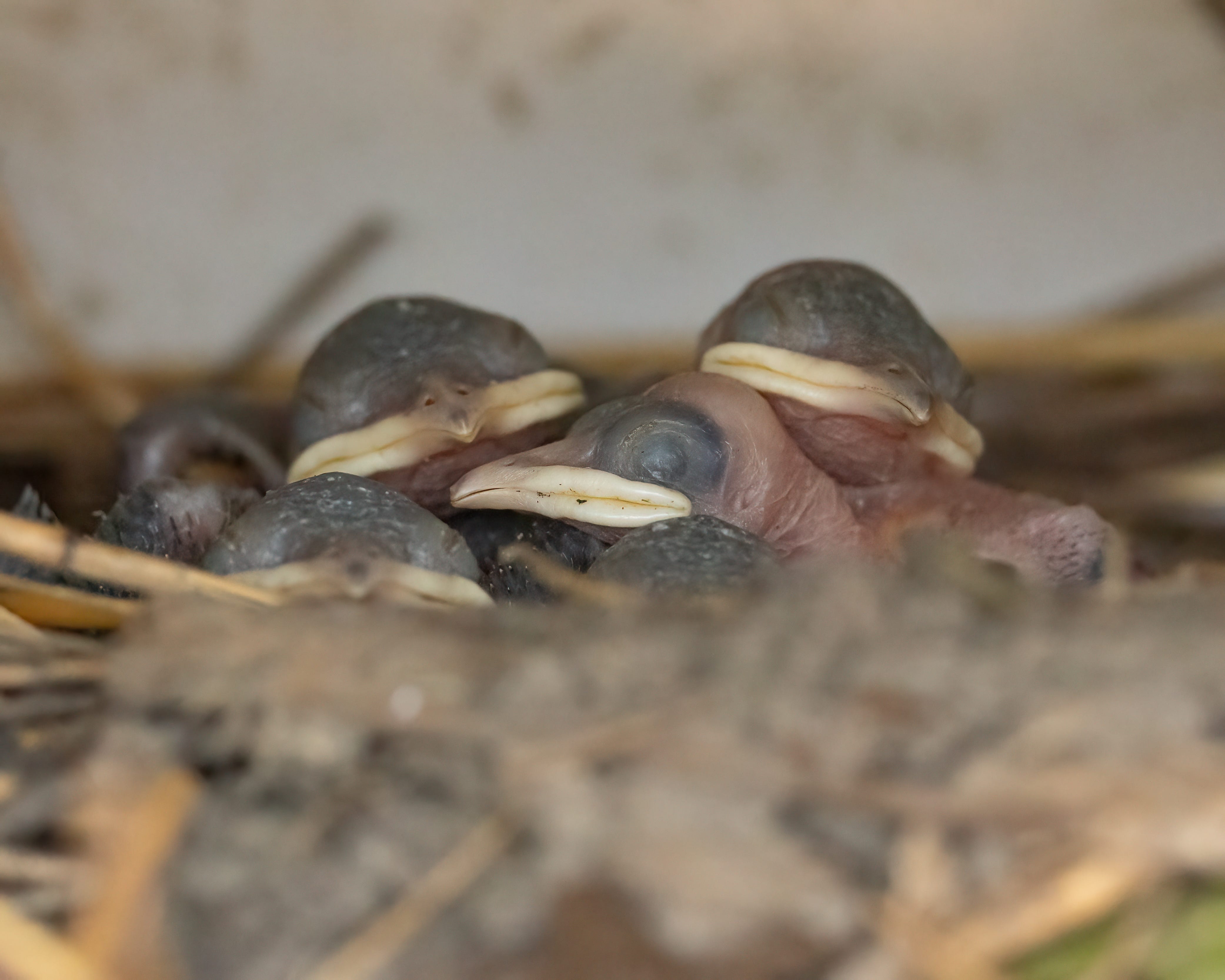
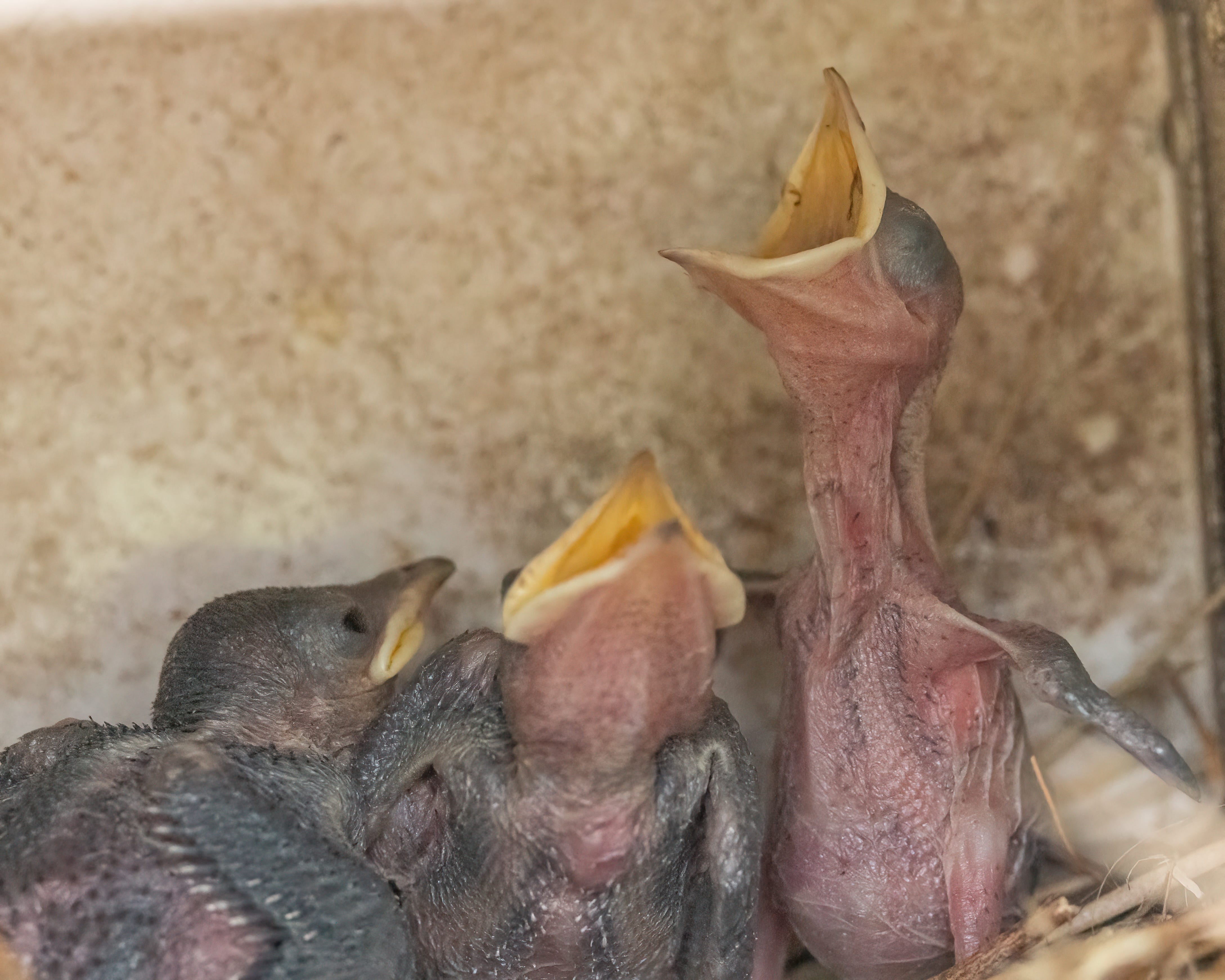
I was not surprised by the kids reactions. We have felt the pull of these birds many times over the past few years. It is why we decided to put up more Martin houses around our community. At first we worried we would not find enough people to tend them. We thought we were asking busy people to take on one more chore.
It was the opposite. People fell for the Martins and could not stay away. They recruited their friends. Soon we had more hands than boxes, enough that they banded into groups to share the work. One of them told us it was the highlight of her week.
At first the response surprised us. Now I see it as part of a larger pattern. Britain offers a striking measure of this shift. A study by the Royal Society for the Protection of Birds found that regular birdwatching has grown 47% in eight years. Among the young, the rise is steepest, more than tenfold since 2018.
Some call it an analog movement, young people putting the phone down on purpose, reaching for something slower and alive. The children at our box did it without being asked. A generation is recalibrating by tuning into birds. But statistics only tell you that something is happening. They do not tell you what a bird can do for a person. For that, I think of our friend, a therapist and one of her clients. She sits with a lot of young people who are struggling with depression, and she told us about one client, a young woman so sad and shut in that she had stopped leaving her house. Our friend gave her one small, concrete thing to do: “Look out the window. Find a bird. Watch it, and come back next week and tell me what you saw.”
The young woman returned a week later. She hadn’t just looked; she had counted ten distinct kinds of birds, all entirely busy with their lives. She watched them go about the morning, each intent on its own small errands, and somewhere in the watching, the tight, hard loop of her own thoughts loosened. For a while, she was no longer trapped inside the small room of her own sadness. She was outside the window, pulling the world into view, and it let her breathe.
I think about that young woman a lot because the loop she was trapped in is one our dominant culture builds for us. A consumer culture constantly trains us to feel a lack that never closes. It prompts us to want, to worry, and to guard, until even those of us living comfortable lives come to feel poor. This is not the scarcity of an empty refrigerator. It is the other kind, the one that lives in a full house. This manufactured scarcity drives us inward, fixing our attention strictly on our own anxieties and walling us off from one another.
But we are not built to live in such narrow cages. We evolved in reciprocity and community, shaped by connection to a living world. Turning back toward that world isn’t an effort; it’s a relief. The young woman at the window wasn’t trying to fix herself. She was simply a creature made for connection, connecting briefly with ten busy birds on an ordinary morning, and remembering that the world is full.
We often treat being well as the absence of stress, a matter of removing what troubles us. But her trouble was not removed. What changed was that she found something beyond herself to attend to, a world going about its life without her, and yet holding space for her within it. That is the other half of mental health: not the absence of pressure, but the presence of meaning. And meaning is almost always a line anchored to something larger than the self, a purpose that points away from us and toward the world.
There is a reason birdwatching is taking hold of a generation who grew up with phones and social media. When you watch a bird, the mind gets quiet. You give the bird your attention, and the bird gives you back a wider world, the shape of the wind, the dragonfly’s wing, the near life you had been walking right past. The more you attend, the more there is to receive. Attention creates an opening, and what comes through is life.
You can walk around our lake in ten minutes, and in the evenings people do, a slow procession of walkers, strollers, and dogs, going around. The Martins circle above us and the water, but their circle does not close. It widens. They rise in loose loops, up and up, until they are specks, until they are gone, and the same birds that were swooping over our little lake will trace an arc that reaches Brazil and comes back. The circle that begins above a lake in Illinois crosses over the Amazon.
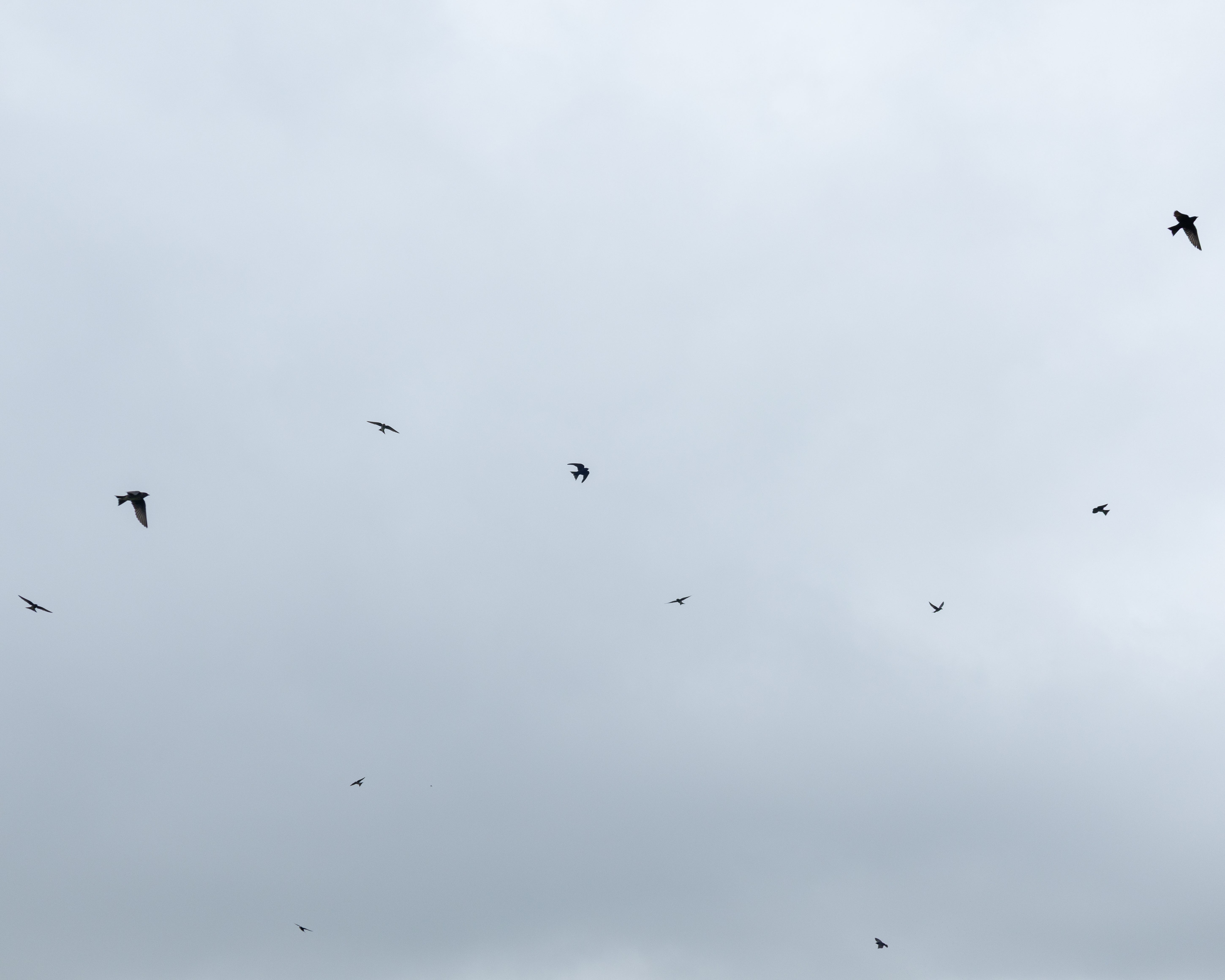
There are circles everywhere once you begin to see them. The dark wet eye of the nestling looking up from the box. Your own eye bent to the opening. The compound eye of the dragonfly contains a thousand small circles inside the one. Poets have stood under this same sky and felt it, the pull to live outward in widening ripples, to let the one life open past itself. The whole air above the colony is turning, arc within arc, a net of circles thrown across the sky.
Our minds also move in circles. Sometimes they are the tight kind, the small hard loops our thoughts make when they turn on themselves, around and around the same worry, the same want, the same narrow room. The young woman at the window knew that circle. Most of us do. But there is another way for a circle to turn. Watch the Martins long enough and something in you lifts with them, and the loop loosens, and the thought that was going around a small dark room begins instead to rise, and widen, and trace a broad arc across the earth.
The latest Living Bird Magazine from the Cornell Lab of Ornithology arrived last week. I opened it to an article on what birding does to the brain. Researchers studying attention have found that people who have watched birds for years seem to carry the mark of it in their brains, growing denser in the areas used to perceive and attend. Birding, one of them wrote, turns passing moments into lasting knowledge.
That is the oldest work the mind knows how to do, the turning of what we notice into what we understand. The mark is not only in the tissue; it accrues in a life. Each morning you spend watching lays something down that stays, until, without meaning to, you have built a reserve of steadiness you can draw on when you have lost your way.
I think of the Polynesian navigators Wade Davis writes about, who crossed thousands of miles of open ocean with no instrument but their own attention. They learned hundreds of stars by name. They read the swells moving through the hull of the canoe, several distinct swells at once, and knew from the pitch and roll if the course had shifted in the night. They read the clouds, the light, the flight of birds. And most astonishing of all, they could pull an unseen island out of the sea, reading the way the waves bent around it long before it climbed over the horizon. Sitting still in the dark of the boat, taking in everything, the whole body an instrument, they knew exactly where they were.
I will never read the ocean like that. But I have felt the smallest edge of what they know. Learn to watch, even a little, and you begin to pull birds out of the sky the way the navigator pulls islands from the sea, the same act, made small. The blank air turns out to have been full the whole time. You tune in, and there are more birds. You keep tuning, and there is more world, the insects, the light, the wind. And somewhere in the widening you find there is more of you, more awake, more here.
More birds. More world. More life.
We finish the nest check and begin to crank the house back up the pole. As soon as it starts to rise, I notice a change in the Martins. They have scattered high into the sky, and now, one by one, they turn and begin to descend. They have been watching the whole time. The moment their home returns to its place, they come back to it.
The box comes to rest near the top of the pole and we are surrounded. Martins swirl around us, dragonflies and moths crosswise in their bills, and then they come streaming down to the house to feed their young.
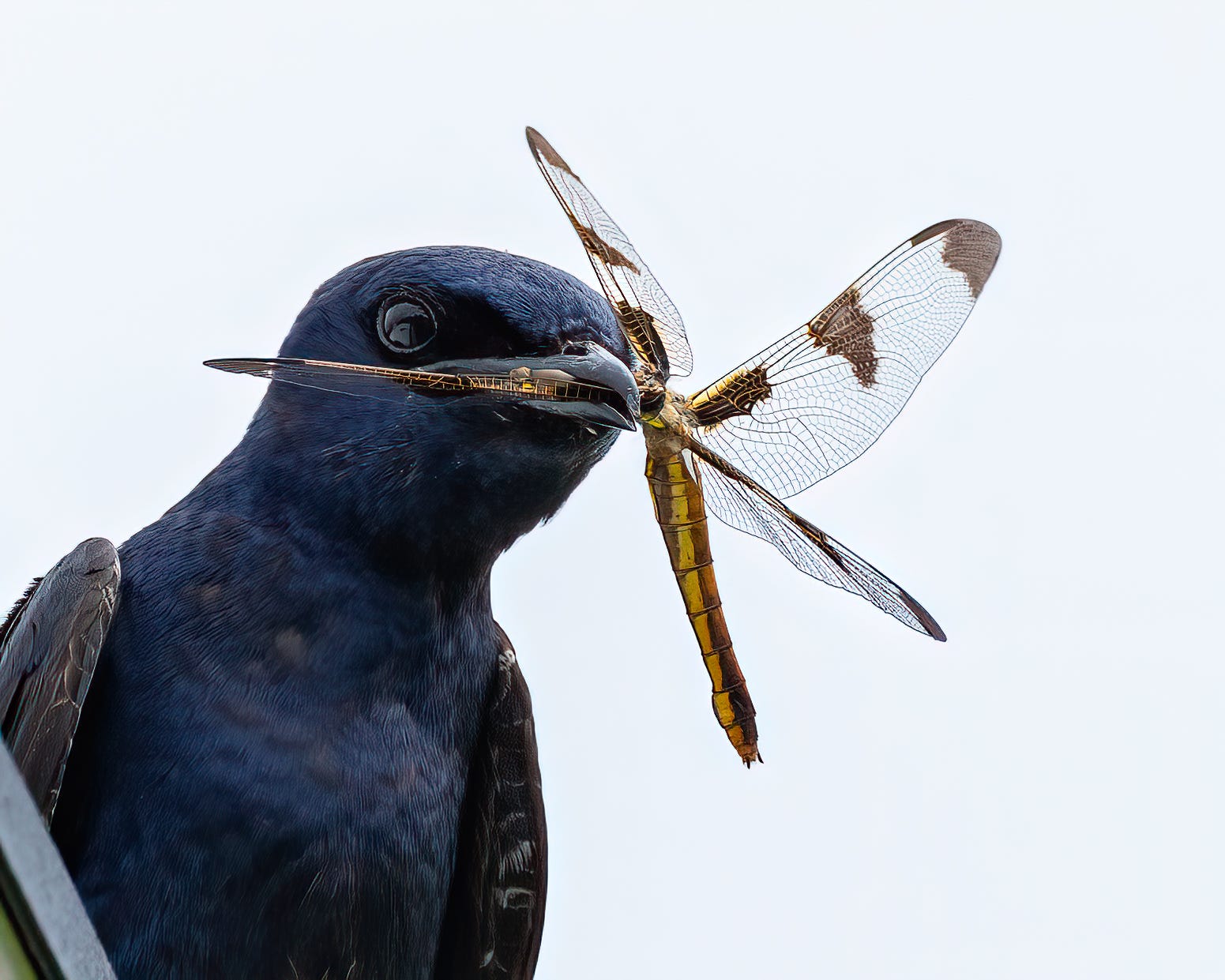
I look up into the swirl and follow them, the arc of one bird and then another, the arc of a dragonfly, the crossing paths of all of them at once. The sky is full of threads. It is a net, woven and rewoven by everything that moves through it.
And the net holds. It holds the Martin and the dragonfly, the hunter and the hunted. It holds the child at the box and the old man on the trail. It holds the sad and the well, the near and the far, the living and the long since gone. It holds Illinois and it holds Brazil. It was here before us and it will be here after us, and every small attention we pay is one more thread drawn tight, one more knot tied, one more length of it woven while we are witness to it.
A Martin lands above me on a perch with a dragonfly held in his beak. The dragonfly’s wings are still open. Her long body still curls. And her head is still turning, catching the last of the light, taking in the world she is about to leave.
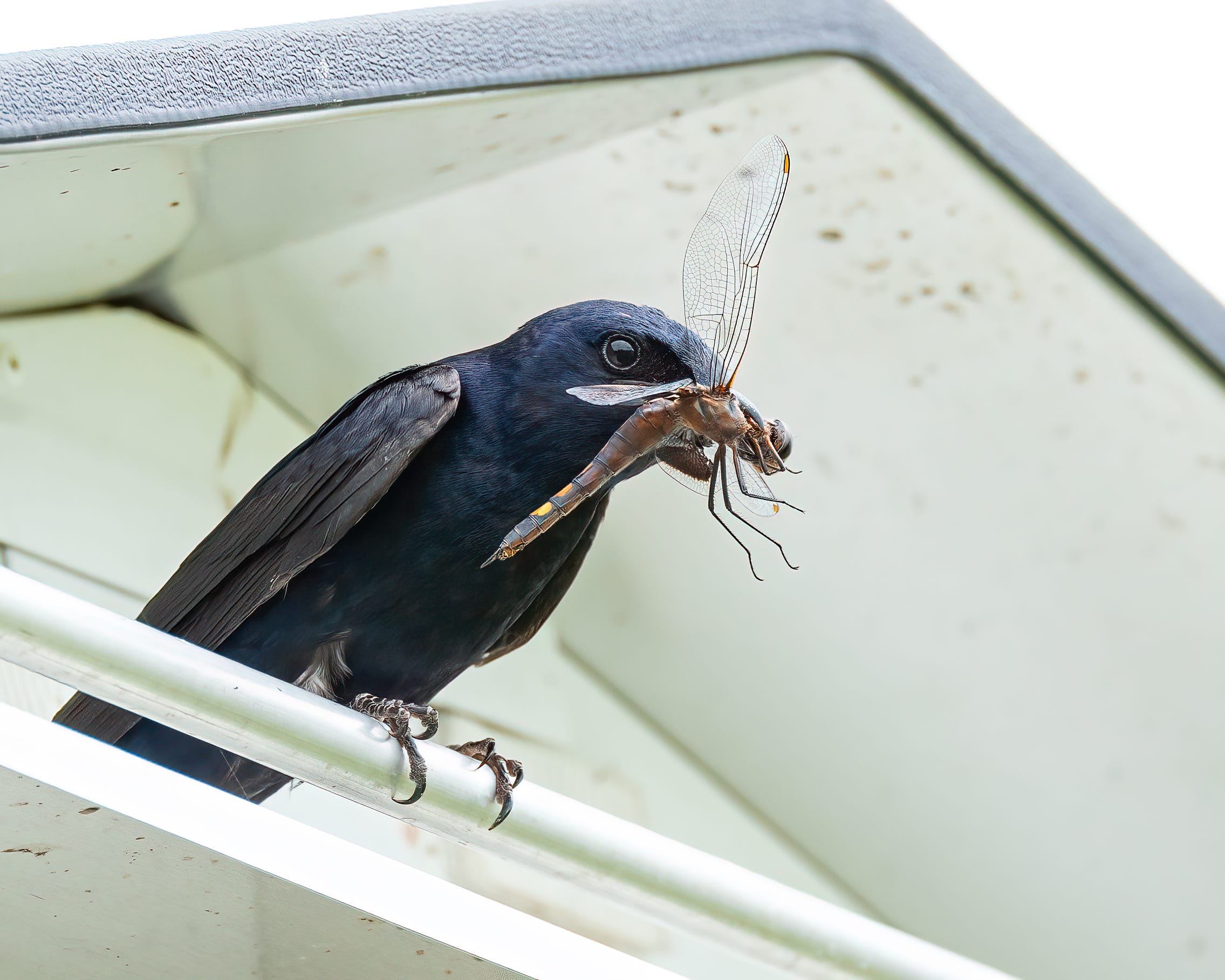
I lean in close, the way I did at the start, over the broken dragonfly in my hand. But this eye is whole, and living. It is not one eye. It is thousands, thousands of small lenses set side by side, each a facet looking out on its own sliver of the world. No single one of them sees much, just a dot of light, a fragment. But the dragonfly gathers them all at once, every facet contributing to one wide picture that sees almost everything. That is the trick we forget. We press our faces to the single narrow lens of our own worries and mistake the small dark room of the self for the whole world. To watch a bird is to open another facet. And another.
The Martin shifts its grip. For one more moment the dragonfly holds on, wings spread, its thousand eyes still bright, still gathering the light.
Then it is gone into the dark of the box, into the open mouths, into the net.
this is my absolute favorite essay of yours, bill. i lived deep in the woods for 20 years, having very few visuals of the birds that i would hear. last june my house burned down, sadly, and we left our hollow. now i live in an old town and have the tallest tree, a silver maple, in the corner of my yard. it is home to so many birds and i have a wide open swath of sky to watch them and grass as well. it is the very best part of living here. thank you for your words and images and the deep possibility of loosening that which is held tightly, inside all of us. be well!
The scarcity of a full house, trapping us in narrow loneliness. The option to soar in the wide circles of life. Such a beautiful call to step outside into kinship. Thank you. 🙏