
Through the Whole Plant

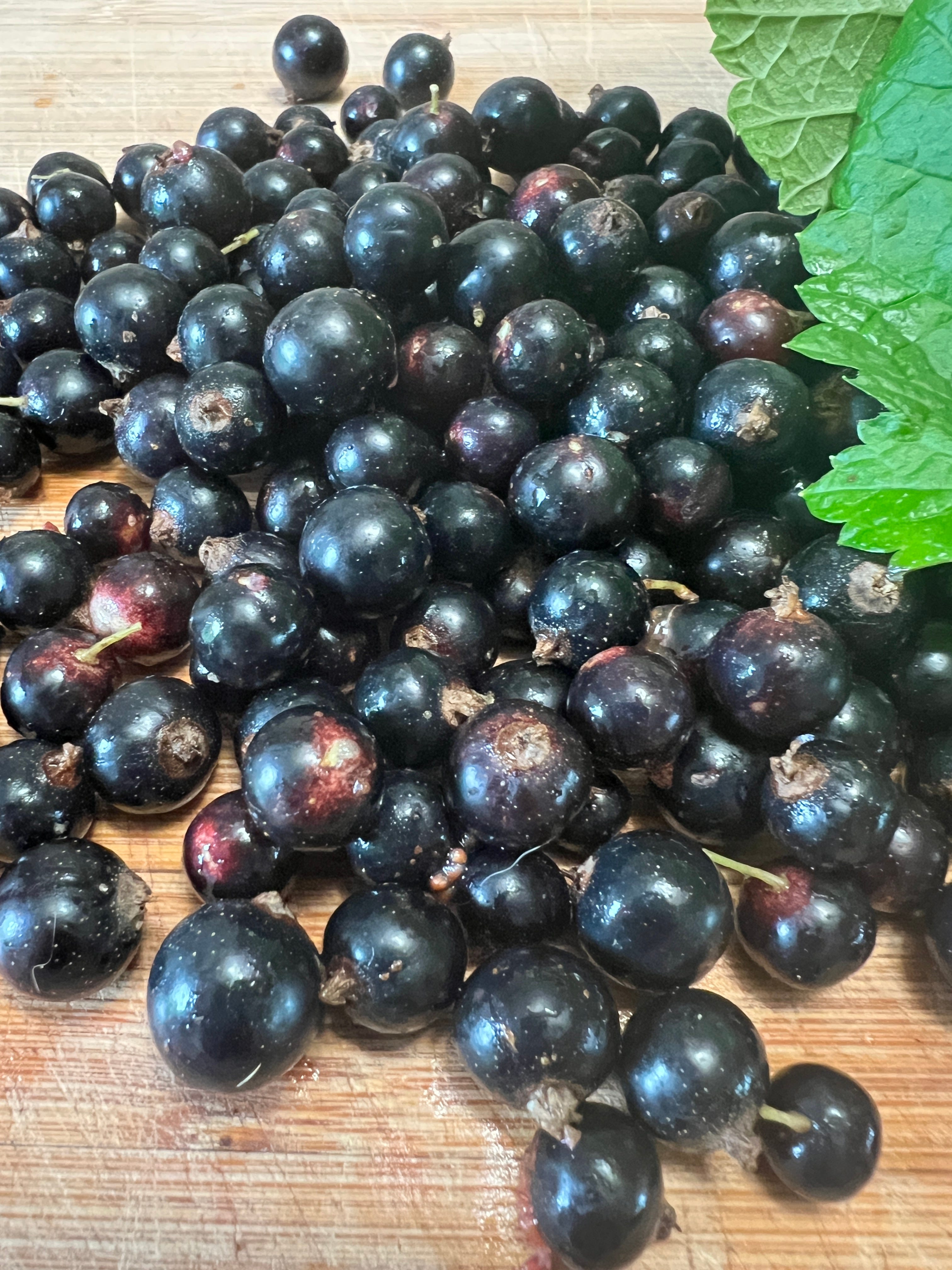
I bend and push a stem aside, and there, low in the shade, is a heavy cluster of ripe berries. I work my hand in through the leaves, careful, feeling for them more than seeing them, and I am so lost in the reaching that the high thin whine circling my head barely registers. My fingers close on the cluster just as the mosquito settles on my cheek. I am easing the berries loose, one at a time, when the bite begins to burn.
Across the garden another currant bush is shaking, a catbird somewhere inside it, working the berries the way I am working mine. For the past two weeks, I have watched them at it, the Robins and the Catbirds, taking their share. I go back to my own cluster, plucking the ripe shiny black ones, leaving the reddish-black ones to ripen more fully. At first I am only harvesting, intent on the work. Then my fingers brush the leaves and the Black Currant releases its scent, green and resinous, a sharpness like pine, and I draw it in without meaning to. My shoulders drop. The picking slows to a rhythm I am no longer driving. I think of Robin Wall Kimmerer, and her book The Serviceberry, where she gathers fruit with gratitude and a sense of reciprocity, and calls it a way of living inside a climate of sufficiency.
Later, I walked back to the edge of the garden, stood beside the pear tree, and looked out across the beds where I have planted Black Currants. The one near the raspberries is crowded, smaller in stature, its leaves dull, its berries few. The plant in the middle of the garden stands in the open. Over the winter I pruned out old canes, in spring I mulched with wood chips and weeded a four-foot circle around the shrub, and the plant has responded with eighteen inches of new growth and broad, glossy leaves. I clipped four short sections of stem from it and carried them inside, where I laid out the whole plant on the counter, stem and leaf, berry and bud.
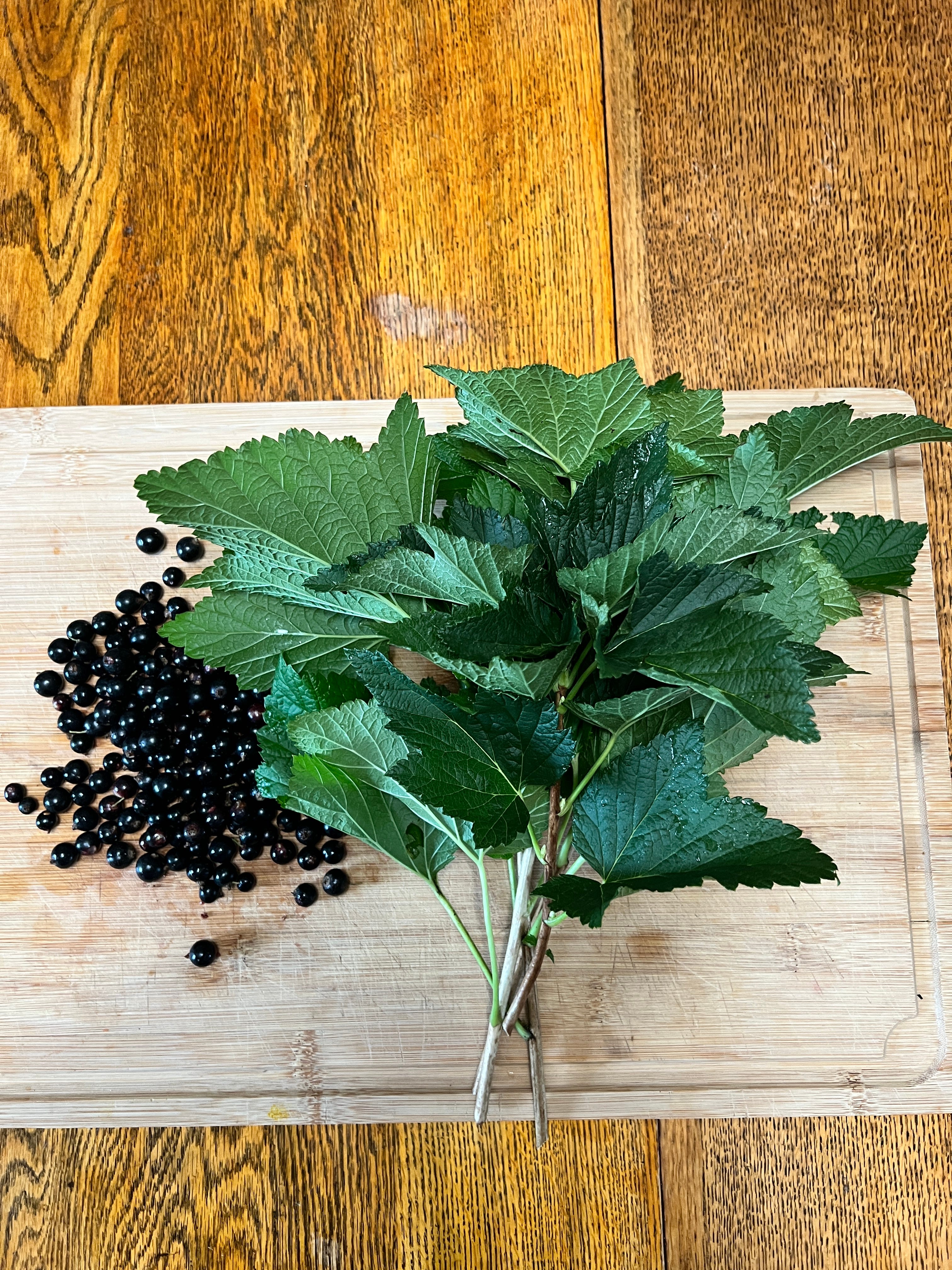
I stood there a while, taking them in. Then I went looking for a way to make tea, and found that Europe has steeped Black Currant leaves for centuries, and that the trail led on to Japan, to kukicha, twig tea. It began as a lesser thing, the prunings and stems left over after the leaf harvest, handed to the workers on the tea farms. Over time the recipe was refined, and the humble tea became a touchstone, a taste of home and of rural life. There was something fitting in that, a tradition built from the parts that were ussually thrown away, and I wanted to see what the same attention would draw out of the Black Currant.
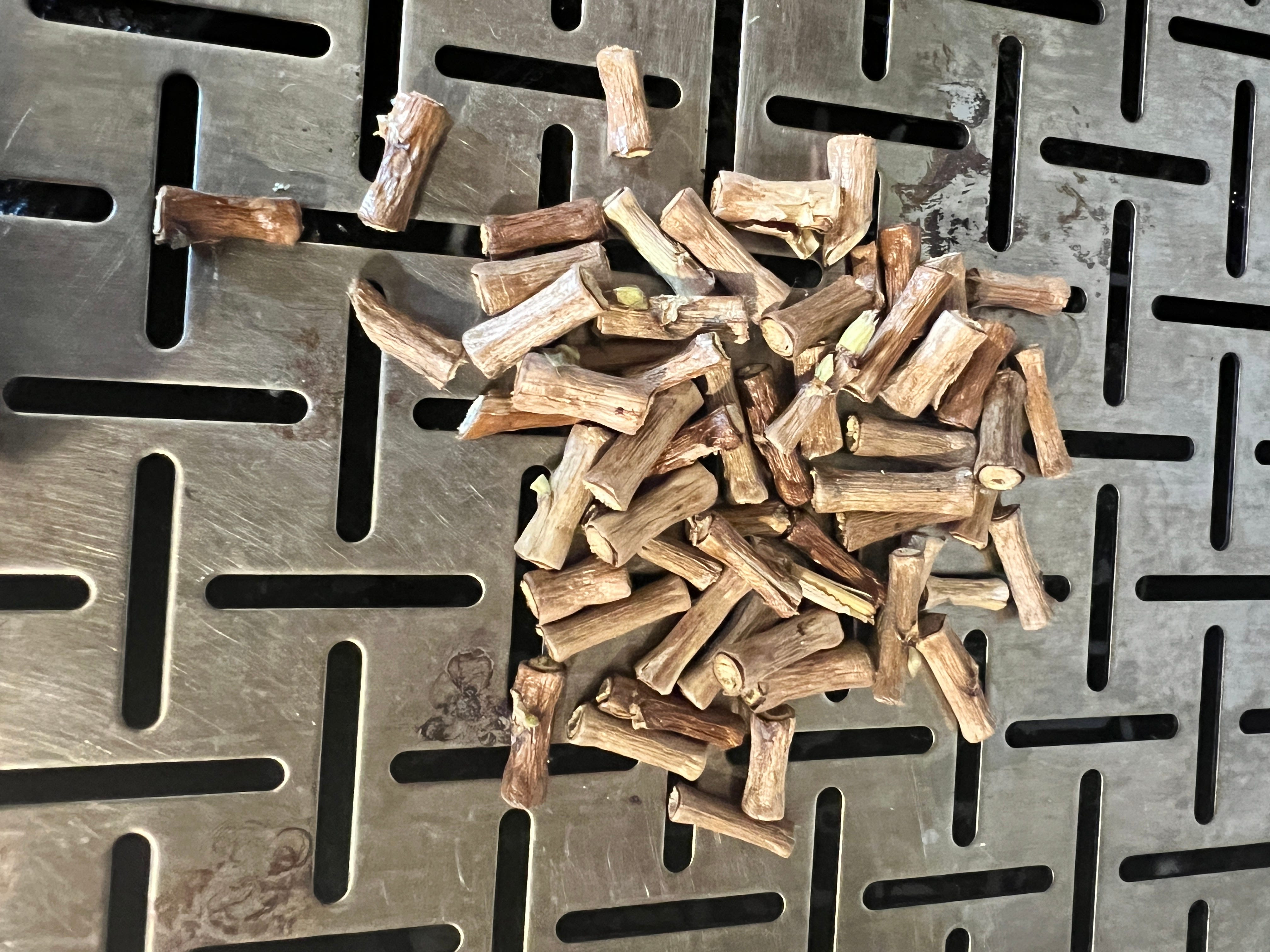
So I followed the old method and let the plant correct me where I was wrong. I wilted the leaves in a hot pan and finished drying them in a dehydrator. The stems I cut into short lengths and set in the oven to roast, waiting for them to darken and match the description in the recipe. They never did. They shrank and dried. They gave off a toasted sweetness, then began to lose it, but they stayed the pale brown of bare wood no matter how long I left them. The color I was waiting for was not coming. The plant was telling me that I would have to know it was ready some other way, by the smell and not the eye. I took the stems out when the kitchen smelled faintly of toast.
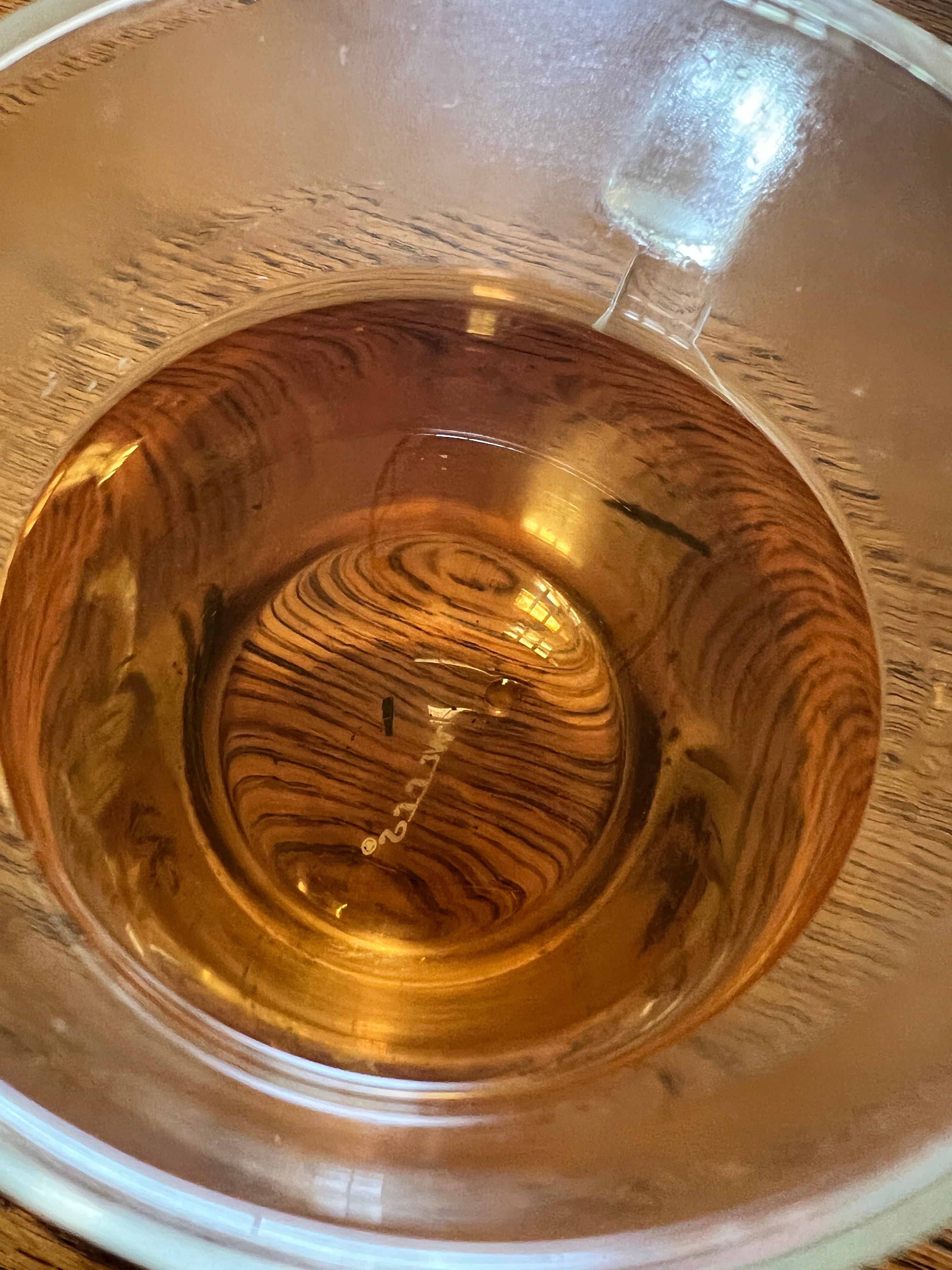
I lightly simmered the roasted stems for six minutes and the water turned a deep amber. The first taste had the smell ahead of it, toast and a dark caramel and somewhere under that, the resin of pine. Then the flavor, sweet at the front, with a tannic grip at the back that dried the sides of my mouth.
The leaves brewed up a bright yellow, mild, with something earthy beneath the mildness, the quietest of the three.
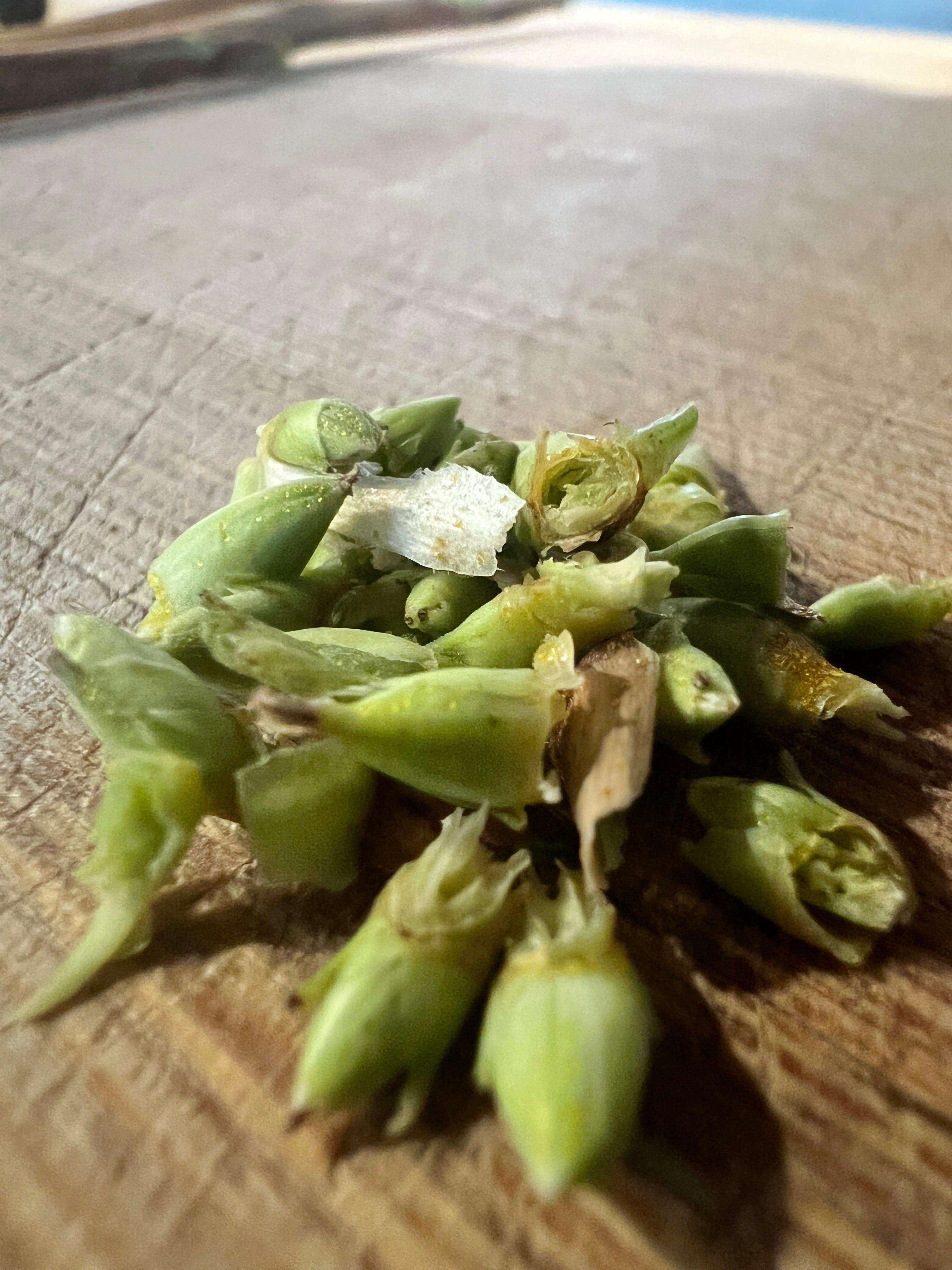
The buds I almost didn’t trust. Five of them in a little water threw off a clear liquor with the strongest character of all, pungent, catty, a sharpness that crowded the nose and read at first as something gone slightly wrong. It was not an appetizing smell. It did not invite me in. And yet there was something in it I wanted to go back to, the green concentrate of the whole plant, new life waiting to be released, intriguing in the way a strong cheese is intriguing, the off-note and the depth impossible to separate.
Then I poured all three into one cup. They fused. The sharp and the mild and the sweet found each other and settled, and what had been three strange and partial things became one. The plant, rejoined.
As I sat with the cup, the plant went on teaching. My mouth registered a grip at first, a dryness along the sides of the tongue, and I thought I had ruined it, steeped the stems too long and pulled the tannins out of the wood. But I had not done anything that needed undoing. As the tea cooled and I kept drinking, the grip softened on its own, and as it softened the cup turned luscious, an improbable richness rising as the tannin let go. I had reached for a mistake to correct and found instead that the tea only asked me to wait. What was left in the mouth was something you feel more than taste. One body nourishing another.
That feeling of nourishment was still with me later that day when I listened to Andrew Weil and Wade Davis talk about coca on the Tim Ferriss podcast. They spoke of a plant the outside world has badly misunderstood, sacred for thousands of years to the people of the Andes, woven into their work and their worship, their greetings and their grief. The war on it, they said, was never only a war on a drug. It was a war on the people who hold it, on a way of living with the world that the conquering mind could not abide and set out to erase.
What stayed with me was a gesture. In the Andes a person takes three coca leaves, stacks them into a small fan, holds them up, and breathes through them, sending the breath to the mountains and the earth before chewing a single leaf. They call it a k’intu, and it is everywhere in the life of the people. Two travelers meeting on a mountain trail will exchange it before they speak of anything else. It is laid into the great offerings to the earth each August, folded into the bundles a healer reads like a map, carried to the thresholds of a life, its plantings and marriages and burials. The plant is the thread the whole culture is woven on, and the principle it teaches is always the same one. The offering comes first. You give before you take. I sat with that for a while, my cup beside me, and understood that I had no such gesture, that I had drunk the whole plant down and thanked nothing.
I walked past my neighbors’ houses after dinner, traversing a linear grid of uniform lawns, straight lines of choking green, quiet and perfectly even. Then came the sound of disconnection, the near-constant grind of a mower, the high whine of a leaf blower, so much energy and effort directed toward stasis.
I looked up as the sound of the wind drew my attention into the canopy of one of my favorite bur oaks in the neighborhood. The leaves shook. One released, floated through the air, spinning in slow motion, until it settled on the tips of the Kentucky bluegrass, perched on the monoculture. We, like the leaf, have drifted into monoculture gradually, almost unknowingly.
When I finished my evening walk, I turned off the sidewalk into my own backyard and stood before the rustling Black Currant, the one I had pruned and mulched and weeded, the one whose whole body I had finally come to know. The day had not been easy. The harvest was hot and slow, the air close, mosquitoes at my ears the whole time, and making tea went on for hours, the wilting and the roasting and the waiting, the kind of fuss a person could be forgiven for not bothering with. But I have bought a great many easy things, and I can tell you I valued none of them the way I valued that cup. I had spent the day in the plant’s company, taken the parts most people leave behind, learned the way it tells you it is ready. That was the offering. Not three leaves lifted to a mountain, but this, a plant tended and a tea made, attention paid to a being emerging through a crack in the monoculture.
A culture that holds the world in reverence is not built by decree. It is built the way a garden is, one person and one plant at a time, small acts of attention accumulating into a way of being.
Inside, the cup was still on the counter, gone cool. I lifted it, and the smell of the whole plant rose to meet me, toast and green resin with dark sweetness underneath, drifting up, breath meeting breath.
Bill, your words felt like a deep dive into presence and what it feels like to simply be wholehearted with what you are doing. Thank you.
I love how your curiosity led you to this holy place of regard for that generous currant. Such a lovely read this morning, Bill.